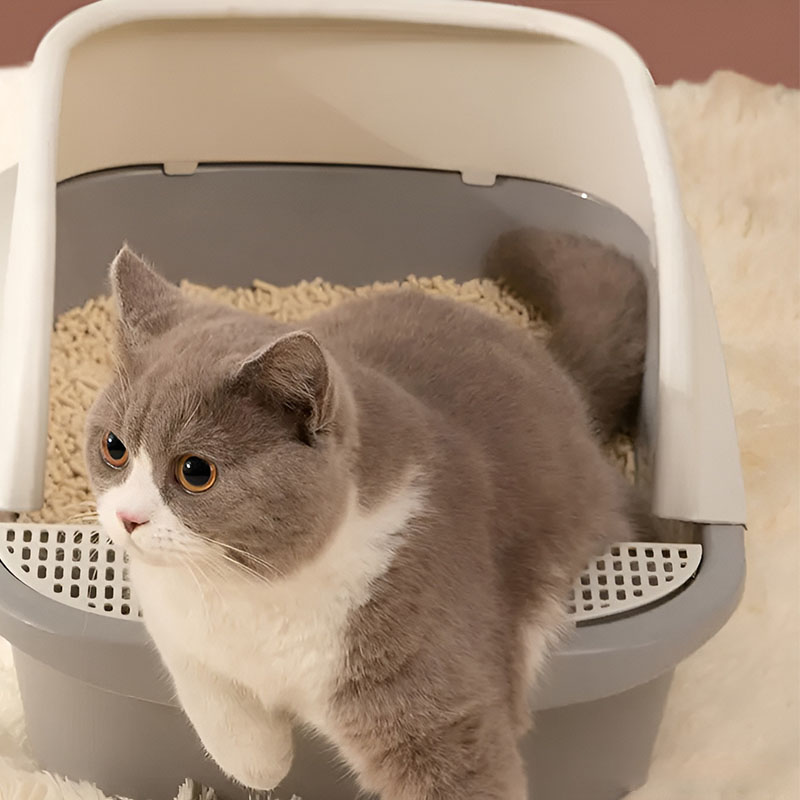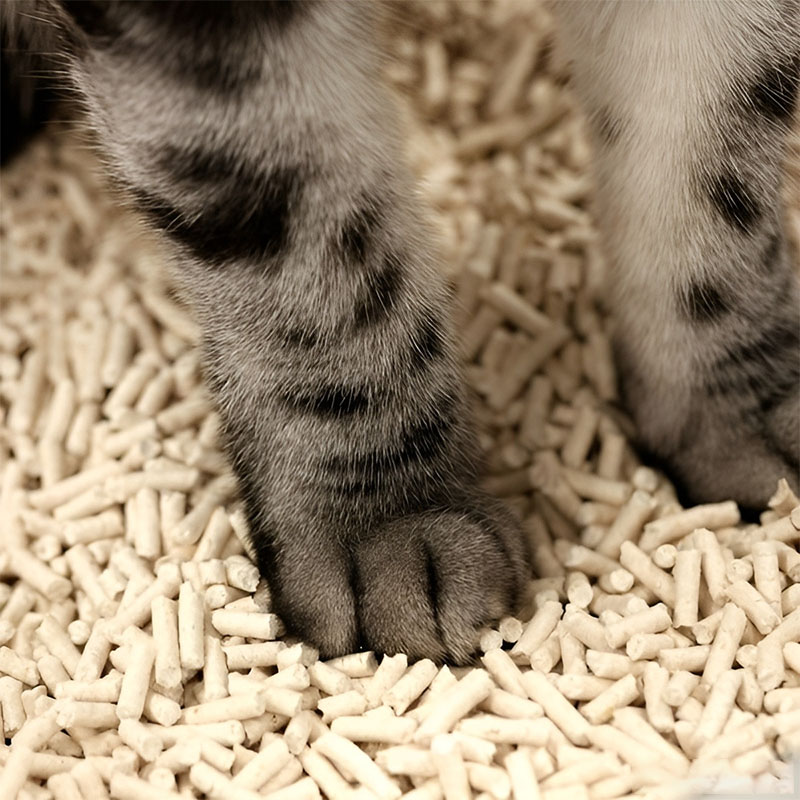
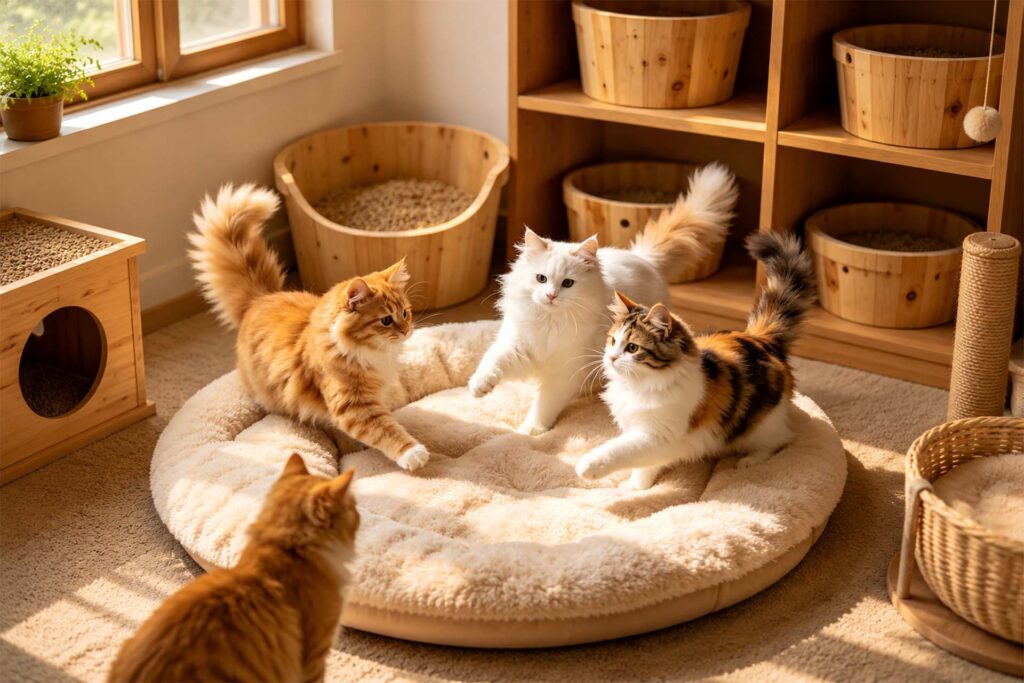
Multi-cat ownership has become an increasingly common lifestyle among modern pet families. Compared with single-cat households, multi-cat environments involve higher litter box usage frequency, larger volumes of waste, faster odor accumulation, and more demanding hygiene management requirements. As a result, choosing the right Multi-cat cat litter has become one of the most important factors affecting both feline health and household cleanliness.
Cat litter is not simply a daily consumable product. In multi-cat households, it functions as the primary hygiene-control medium responsible for odor management, moisture absorption, bacterial isolation, and environmental cleanliness. The quality of Multi-cat cat litter directly influences indoor air quality, litter box sanitation, respiratory health, and the long-term comfort of both cats and owners.
Many cat owners mistakenly apply single-cat purchasing logic when selecting litter for multi-cat environments. However, cat litter that performs adequately in a low-frequency usage scenario may fail completely under continuous multi-cat use. Problems such as loose clumping, bottom adhesion, excessive dust, rapid odor spread, and accelerated bacterial growth become significantly more severe in high-density cat environments.
At the same time, the Multi-cat cat litter products available on the market vary greatly in raw material composition, clumping technology, adsorption performance, dust control, and wear resistance. Different cat litter manufacturers adopt different mineral ratios, plant-fiber formulations, and production processes, resulting in major performance differences even within the same litter category.
This professional guide combines the practical litter-management standards commonly used in high-density cat facilities and breeding environments. It analyzes the real pain points faced by multi-cat households and explains the key purchasing logic behind Multi-cat cat litter selection. By focusing on the two most important indicators—clumping performance and deodorization efficiency—this article helps cat owners avoid misleading marketing tactics and make rational, long-term litter choices.
I. Why Multi-Cat Cat Litter Requires Higher Performance Standards
There is a fundamental operational difference between a single-cat litter environment and a multi-cat litter environment. In single-cat households, owners may tolerate minor dust, moderate odor retention, or slower clumping speed. However, Multi-cat cat litter must meet significantly stricter performance standards because the litter box experiences continuous and repeated use throughout the day.
In high-density cat households, the weaknesses of poor-quality cat litter become magnified rapidly. Common problems include:
- Persistent ammonia odor
- Accelerated bacterial growth
- Urine saturation at the bottom of the litter box
- Cross-contamination between cats
- Stress-induced urination issues
- Increased cleaning frequency
- Reduced litter lifespan
For long-term multi-cat management, selecting appropriate Multi-cat cat litter is essential for maintaining hygiene stability and minimizing household maintenance pressure.
Clumping Stability Is the Primary Requirement
Clumping performance is the most critical technical indicator in Multi-cat cat litter selection.
In multi-cat households, several cats may use the litter box consecutively within short periods. If the litter absorbs slowly or forms unstable clumps, urine quickly penetrates into the lower litter layer and accumulates at the base of the box, eventually forming stubborn urine scale and bacterial buildup.
Soft or fragile clumps create additional problems. When cats step on partially formed clumps, the material breaks apart and mixes contaminated particles back into the clean litter layer. This continuous contamination accelerates odor spread and reduces overall litter efficiency.
High-quality Multi-cat cat litter must provide:
- Rapid moisture absorption
- Fast clump formation
- High clump hardness
- Strong pressure resistance
- Minimal fragmentation
- Low bottom adhesion
Professional cat litter manufacturers often formulate Multi-cat cat litter specifically for high-frequency usage environments. These products usually feature enhanced bonding density, optimized mineral composition, and reinforced clump stability to withstand repeated multi-cat usage.
Deodorization Is the Second Core Requirement
Odor control is equally important in Multi-cat cat litter systems.
Cat waste naturally releases ammonia and organic odors. In multi-cat environments, overlapping excretion events cause odor concentration to rise rapidly. Without strong deodorization performance, smells can penetrate furniture, flooring, curtains, and walls, becoming difficult to eliminate.
Low-quality deodorizing litter often relies heavily on artificial fragrance masking. While this may temporarily reduce odor perception, synthetic fragrance dissipates quickly, allowing trapped ammonia odors to return even more aggressively. In many cases, the combination of perfume and waste odor creates a stronger and more irritating smell.
Professional-grade Multi-cat cat litter generally relies on:
- Physical encapsulation
- Activated carbon adsorption
- Mineral odor absorption
- Long-term moisture isolation
These methods provide more stable odor control without overstimulating cats’ sensitive respiratory and olfactory systems.
Low Dust and Wear Resistance Are Also Essential
Because multiple cats continuously dig, scratch, and move around the litter box, dust control becomes especially important in Multi-cat cat litter selection.
High-dust litter can continuously release airborne particles, negatively affecting indoor air quality and potentially irritating feline respiratory systems. Poor wear resistance also causes litter particles to break down into powder more quickly, increasing litter consumption and overall maintenance costs.
In professional cat breeding facilities and high-density cat environments, low-dust, high-durability litter is considered a basic operational requirement. Most facilities prioritize litter that forms hard clumps, maintains structural integrity, and minimizes particle breakdown during extended use.
For household multi-cat management, these same professional standards provide valuable guidance.
II. Real Performance Comparison of Different Multi-Cat Cat Litter Types
Different litter materials perform very differently in multi-cat environments. Many consumers choose litter based solely on price or internet popularity while ignoring whether the product is suitable for high-frequency usage.
Based on long-term usage feedback from professional cat facilities, the following is a realistic analysis of common Multi-cat cat litter categories.
Mixed Cat Litter: The Most Balanced Multi-Cat Cat Litter Option
Mixed cat litter is currently considered one of the most practical and balanced solutions for multi-cat households.
Most premium Multi-cat cat litter formulas combine:
- Bentonite minerals
- Tofu litter particles
- Activated carbon
- Natural plant fibers
This combination allows manufacturers to integrate multiple performance advantages into a single product.
The bentonite component improves moisture absorption speed and clumping efficiency. Plant fibers enhance structural stability while reducing dust generation. Activated carbon helps adsorb odor molecules and delay odor spread.
Compared with single-material litter systems, mixed Multi-cat cat litter generally provides:
- Better pressure resistance
- Longer litter lifespan
- Lower bottom adhesion
- More stable clumping
- Improved odor control
- Reduced dust levels
Whether in household multi-cat settings or large-scale breeding facilities, mixed cat litter usually delivers the most balanced long-term performance.
High-Quality Bentonite Cat Litter
Premium bentonite litter remains a strong option for households prioritizing clumping speed and odor sealing performance.
Mineral-based bentonite particles feature high density and rapid absorption capability. Once exposed to moisture, they form compact clumps quickly and effectively isolate odor within the clump structure.
Additionally, fine mineral particles closely match cats’ natural digging instincts, resulting in extremely high litter acceptance rates.
However, low-grade bentonite litter often suffers from severe dust problems. Multi-cat households should only select low-dust bentonite litter produced through professional dust-removal and polishing processes.
Pure Tofu Cat Litter
Pure tofu litter is generally not ideal as the primary Multi-cat cat litter solution.
Although tofu litter offers very low dust and uses natural ingredients, its absorption speed and structural durability are often insufficient for continuous multi-cat usage.
Under high-frequency urination conditions, tofu litter may:
- Soften excessively
- Form wet sludge layers
- Stick to the bottom
- Break apart under pressure
- Increase cleaning difficulty
Pure tofu litter may still be useful for isolated kitten areas or sensitive cats, but it is less suitable for shared high-density litter box systems.
Pine and Crystal Cat Litter
Niche litter types such as pine litter and crystal litter are usually not recommended for most multi-cat households.
Pine litter tends to disintegrate into damp powder after moisture exposure, creating bacterial growth risks and increasing maintenance complexity.
Crystal litter relies mainly on adsorption rather than clumping. In multi-cat environments, adsorption capacity becomes saturated quickly, causing rapid odor buildup and requiring frequent complete litter replacement.
These specialty products are generally better suited to specific controlled breeding scenarios rather than everyday household multi-cat management.
III. The Most Important Factors in Multi-Cat Cat Litter Selection
When selecting Multi-cat cat litter, cat owners should avoid being distracted by secondary marketing features such as appearance, fragrance intensity, color variation, or flushability claims.
Instead, purchasing decisions should focus primarily on two professional indicators:
- Clumping performance
- Deodorization efficiency
How to Evaluate Clumping Performance
Professional Multi-cat cat litter should form stable clumps within approximately three to five seconds after urine exposure. Rapid clumping minimizes moisture spread and prevents deep-layer contamination.
Clump hardness is equally important. When scooped, the clumps should remain firm without producing loose debris or collapsing under light pressure.
Bottom adhesion should also be carefully evaluated. Inferior litter often hardens against the base of the litter box, requiring aggressive scraping and creating long-term residue buildup.
Professional cat litter manufacturers typically optimize mineral-to-starch ratios to balance hardness, absorption, and release properties, ensuring stable clumps without excessive sticking.
How to Evaluate Deodorization Performance
During Multi-cat cat litter selection, odorless or lightly deodorizing products are generally preferable to heavily scented litter.
Artificial fragrances may temporarily suppress odor perception, but prolonged exposure can irritate cats and contribute to litter avoidance behaviors.
High-quality deodorizing litter relies primarily on:
- Physical encapsulation
- Carbon adsorption
- Natural mineral absorption
After excretion, qualified Multi-cat cat litter should suppress strong ammonia odor for several hours without relying on overpowering synthetic fragrance.
A practical household test involves closing the litter box for approximately ten minutes after use. If strong odor is not immediately noticeable when reopened, the deodorization system is functioning effectively.
Cat owners should also avoid common misconceptions:
- Ultra-fast clumping is not always safer
- Excessive adhesives may create long-term risks
- More activated carbon does not always mean better performance
- Excessive carbon powder may increase dust contamination
Balanced formulation is more important than exaggerated specifications.
IV. Practical Multi-Cat Cat Litter Maintenance Tips
Even the highest-quality Multi-cat cat litter requires proper management techniques to achieve optimal performance.
Professional cat facilities commonly apply the following practical maintenance methods.
Maintain Proper Litter Depth
Multi-cat households should maintain a litter depth of approximately 7–10 centimeters. Adequate depth helps prevent urine penetration while providing enough digging space for cats.
Follow Proper Litter Box Ratios
A litter box ratio of approximately 1 litter box per cat plus one additional box helps reduce territorial stress and litter box competition.
Scoop Frequently
Clumps should be removed at least twice daily to minimize bacterial growth and prevent odor accumulation.
Replace Litter Regularly
Although complete litter replacement frequency depends on usage intensity, the litter box should still be fully cleaned periodically to remove residual bacteria and stubborn buildup.
Avoid Frequent Brand Changes
Cats adapt strongly to familiar textures and scents. Constantly changing litter brands may increase stress and contribute to inappropriate elimination behaviors.
V. Conclusion: Practical Multi-Cat Cat Litter Selection for Long-Term Cat Ownership
When choosing Multi-cat cat litter, practicality, durability, and long-term stability are far more important than flashy marketing features.
The ideal Multi-cat cat litter should provide:
- Strong clumping performance
- Long-lasting odor control
- Low dust generation
- Stable wear resistance
- Safe and balanced ingredients
Cat owners should prioritize compliant products produced by reliable manufacturers and avoid low-quality bulk litter with unstable formulations and excessive fragrance additives.
By applying the same practical standards used in professional cat facilities and focusing on the two core indicators of deodorization and clumping, multi-cat households can significantly improve hygiene management while reducing maintenance pressure.
Combined with proper cleaning routines and litter box management habits, high-quality Multi-cat cat litter can create a cleaner, healthier, and more comfortable environment for both cats and humans.
Ultimately, suitable Multi-cat cat litter is not just a consumable product—it is one of the most important long-term investments in successful multi-cat living.
FAQ
Why shouldn’t single-cat purchasing logic be applied when buying cat litter for a multi-cat household?
In single-cat homes, a litter box experiences low-frequency use, meaning minor dust or moderate clumping speed may be tolerated. However, multi-cat environments subject the litter box to continuous, repeated daily use. Applying single-cat logic can rapidly magnify the weaknesses of low-quality litter, leading to persistent ammonia odors, soft clumps that break apart under cats’ paws, urine saturation/adhesion at the bottom of the box, and accelerated bacterial growth.
What makes mixed cat litter the most balanced and recommended option for multi-cat homes?
Mixed cat litter integrates multiple materials—typically blending bentonite minerals, tofu litter particles, activated carbon, and natural plant fibers. This combination solves the individual downsides of single-material litters: bentonite ensures rapid absorption and hard clumping; plant fibers reduce dust; and activated carbon physically adsorbs odor molecules. Together, they provide superior pressure resistance, reduced bottom adhesion, and a longer overall litter lifespan capable of handling high-frequency use.
 English
  Spanish
  Russian
  Japanese
  Arabic