Key Takeaways
- AiSha bentonite cat litter curing technology operates at 35-45°C, preserving the mineral micropore structure while forming a tough breathable protective film on every grain.
- Cured grains survive 15 days of continuous high-frequency trampling with complete particle shape, versus ordinary bentonite that pulverizes into muddy residue.
- AiSha maintains loose grain state and stable clumping after 14 consecutive days at 85% relative humidity, outperforming plant-based litter that deteriorates completely.
- Three rounds of slow curing lock the mineral molecular structure, resisting humid air, repeated cat trampling, and long-term storage compression.
- AiSha’s after-sales complaint rate is far below the industry average, reducing B2B after-sales labor and protecting local market reputation.
- Fully automated constant-temperature assembly line production ensures zero batch-to-batch variation for global bulk distributors.
Bentonite Cat Litter Curing Technology: Performance Comparison
| Feature | AiSha Cured Bentonite | Ordinary Bentonite | Plant-Based (Tofu) Litter |
| Curing Temperature | 35-45°C constant slow cure | One-time high-temp drying | Plant starch bonding |
| Grain Integrity (15 days) | Complete particle shape | Pulverized to muddy residue | Fiber fragmentation |
| Humidity Resistance (85% RH) | 14 days stable, no softening | Rapid softening and clumping failure | Mold and complete deterioration |
| Pulverization Risk | Nearly zero | High | Moderate to high |
| Batch Consistency | Zero variation, automated line | Large batch-to-batch differences | Raw-material dependent |
| Best For | Global B2B bulk wholesale | Budget single-use scenarios | Eco-conscious niche market |
1. What Is Bentonite Cat Litter Curing Technology?
For global wholesale distributors and frontline sales teams of local cat litter companies, product durability and environmental adaptability are always the top two factors that determine long-term bulk order cooperation. Most end-user negative reviews and retail repurchase failures stem from two common litter defects: grain pulverization and moisture softening. These problems are extremely prevalent in ordinary mineral cat litter and various plant-based litter products sold on the market.
AiSha bentonite cat litter, a core flagship product exported by cat litter China suppliers, solves these two industry pain points fundamentally through exclusive bentonite cat litter curing technology. This article focuses on the practical principles, terminal usage value, and B2B sales advantages of this core process, providing professional, actionable sales support for every cooperative cat litter company.
1.1 Core Production Logic of the Curing Process
Different from ordinary high-temperature baking and simple surface polishing of traditional cat litter, AiSha’s bentonite cat litter curing technology adopts a constant-temperature slow-forming process maintained between 35°C and 45°C throughout production. This mild temperature environment does not damage the internal mineral micropore structure of sodium bentonite, while forming a dense, tough, and breathable protective film on the outer layer of each litter grain. Many small and medium-sized cat litter companies lack in-depth understanding of this process. They mistakenly believe that all bentonite cat litter has the same grain structure, ignoring that ordinary high-temperature processing causes mineral grain embrittlement, resulting in easy pulverization and poor moisture resistance in daily use.
The biggest feature of AiSha’s curing process is the integration of internal structural stabilization and external layer protection. During production, each grain undergoes three rounds of slow curing and shaping, which locks the mineral molecular structure firmly. This allows AiSha grains to resist external environmental interference including humid air, repeated cat trampling, and long-term storage compression. Compared with plant-based litter such as tofu litter and natural tofu cat litter that rely on plant starch bonding for shaping, AiSha’s mineral curing structure is more stable, non-degradable, and free from fermentation and deterioration risks.
1.2 Process Differences From Ordinary Bentonite Litter
Most cheap bulk bentonite cat litter on the market only adopts one-time high-temperature drying treatment. Although the surface looks dry and neat, the internal grain structure is loose and fragile. After being poured into litter boxes for one to two days, continuous cat digging and slight air humidity cause the grains to break into fine powder. This not only causes floating dust pollution but also leads to rapid failure of clumping performance, bringing frequent after-sales troubles for downstream cat litter company merchants.
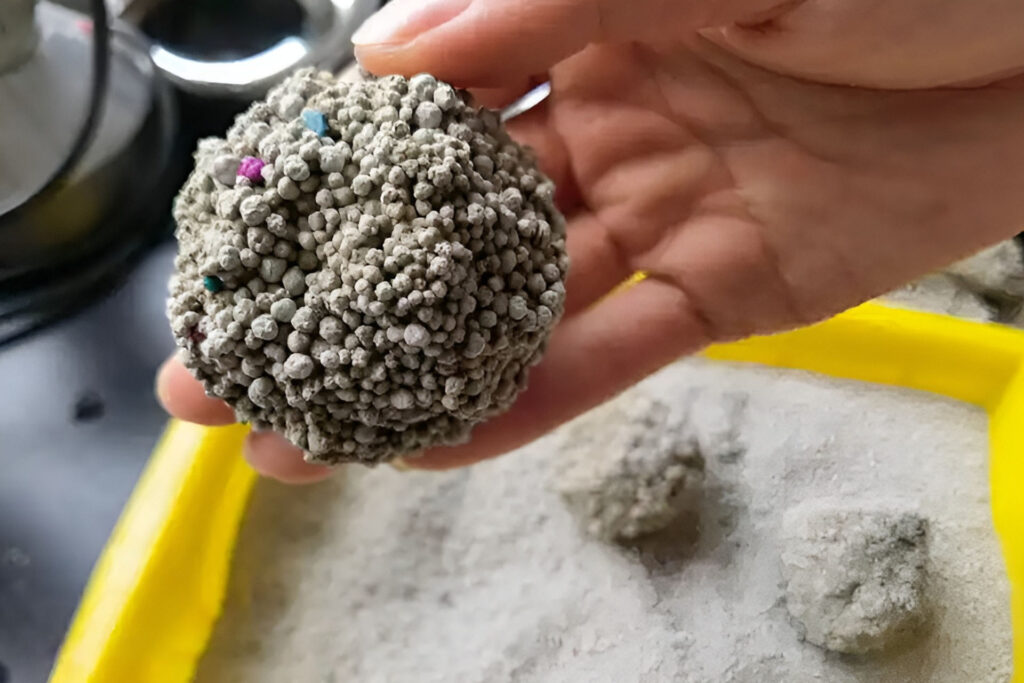
AiSha completely avoids this defect through bentonite cat litter curing technology. The slow temperature control process solidifies the loose mineral particles inside the grains into an integrated dense structure. In actual batch tests, AiSha grains still maintain complete particle shape after 15 days of continuous high-frequency trampling, while ordinary uncured bentonite litter is completely pulverized into muddy residues. This essential process difference is the core reason why AiSha’s comprehensive usage experience far exceeds conventional mineral litter and mainstream plant litter products in long-term bulk sales.
2. Anti-Pulverization Advantage: Solving Terminal Dust Pain Points
2.1 Anti-Pulverization Performance in Daily Usage
Pulverization is the most criticized problem of mineral cat litter by end consumers. Loose broken grains produce floating dust, stain household floors and furniture, and even irritate cats’ respiratory tracts. For retail stores and breeding customers cooperating with cat litter companies, excessive litter pulverization directly leads to negative reviews, reduced repurchase willingness, and increased after-sales communication costs.
Relying on bentonite cat litter curing technology, AiSha’s grain toughness is greatly improved. Whether it is the vigorous digging behavior of young and active cats, or long-term repeated compression in multi-cat households, the grains will not break and peel in large areas. In actual terminal feedback collected from global bulk customers, AiSha has almost no floating dust and broken residue accumulation after one week of use. This performance is significantly better than tofu litter. Many users report that plant-based litter is prone to fiber fragmentation and fine crumb residue after being trampled, which also causes household cleaning troubles, while cured AiSha grains remain intact and tidy for a long time.
2.2 B2B Profit Value of Anti-Pulverization Performance
For all wholesale merchants operating bulk cat litter business, product durability is directly linked to customer stickiness and profit margin. Litter products that are easy to pulverize have a short service cycle, require frequent full-tray replacement by end users, and seem to drive repeated purchases in the short term. In fact, they quickly lose customer trust due to poor usage experience, resulting in long-term customer loss for the cat litter company.
AiSha’s excellent anti-pulverization performance extends the single-box service cycle by nearly twice compared with ordinary litter and plant-based natural tofu cat litter. For individual household users, it reduces the frequency of litter replacement and household cleaning; for commercial catteries and pet boarding centers with large consumption, it greatly cuts monthly procurement costs and labor costs. Many cooperative cat littercompanies in Europe and Latin America companies in Europe and Latin America have confirmed that AiSha’s stable non-pulverization performance has helped their stores accumulate a large number of high-loyalty retail customers, and the annual repurchase rate of bulk orders has increased significantly.
3. Moisture Resistance: Adapting to Global Climate Challenges
3.1 Curing Film Moisture Isolation Mechanism
Humid air is the biggest natural enemy of cat litter products. Whether it is the long rainy monsoon climate in Southeast Asia and Latin America, or the damp indoor environment caused by seasonal ventilation in European coastal areas, ordinary cat litter will absorb water vapor quickly, resulting in softening, stickiness, and mold growth. AiSha’s bentonite cat litter curing technology forms a dense breathable protective film on the surface of each grain. This film can effectively isolate external water vapor and humid air, while retaining the internal micropore adsorption function required for clumping and deodorization, achieving a perfect balance between moisture resistance and usage performance.
This unique structural design makes AiSha adaptable to almost all global mainstream living environments. Unlike tofu litter, which relies on plant fiber absorption and is extremely afraid of dampness, AiSha’s mineral curing structure will not absorb excess water vapor in humid environments, nor will it produce fermented odor and mold spots. In the seasonal humidity tests, AiSha still maintains loose grain state and stable clumping ability after 14 consecutive days of exposure to 85% high humidity, while most plant-based litter completely deteriorates and fails.
3.2 Scenario Verification in High-Humidity Regions
Coastal and subtropical humid regions are the key sales markets for global cat litter companies, and also the hardest hit area for ordinary cat litter failure. Many local merchants used to take tofu clumping cat litter as their main bulk supply due to the poor moisture resistance of traditional mineral litter. However, plant-based litter’s mold and deterioration problems have always troubled downstream retailers and end users, forming a vicious cycle of customer complaints and product replacement.
After launching AiSha’s cured bulk products, many Latin American and Southeast Asian distributors have completely optimized their product structure. In the actual market verification of bulk cat litter sales, AiSha can stably maintain product performance throughout the rainy season without softening, sticking to the tray, or odor accumulation. For B2B cat litter company merchants, this means zero seasonal product failure risks, stable terminal user experience, and greatly reduced after-sales service pressure. It also solves the long-term market pain point that mineral litter cannot adapt to humid climates and plant litter is prone to deterioration.
3.3 Low-Temperature Anti-Condensation for Cold Regions
In addition to high-humidity environments, dry and cold winter climates in Northern Europe and North America also test litter performance severely. The indoor heating environment leads to extremely low air humidity, and the temperature difference between indoor and outdoor is easy to form local condensation water, making ordinary brittle litter grains crack and pulverize. AiSha’s bentonite cat litter curing technology is originally formed in a mild constant-temperature environment, so the grain structure has strong temperature adaptability and will not crack or peel due to sudden temperature changes.
Compared with tofu litter that is easy to dry and harden in low-temperature environments, AiSha can always maintain moderate grain toughness. This advantage allows northern hemisphere merchants of cat litter companies to achieve stable sales throughout the year, without seasonal sales decline caused by product performance adaptation problems, and further consolidates the market competitiveness of bulk cat litter supplied by cat litter China suppliers.
4. Cross-Product Competitive Gap From Curing Technology
4.1 Cured Mineral Litter vs Plant Litter Stability
All plant-based litter products including tofu litter, natural tofu cat litter, and tofu clumping cat litter belong to organic degradable materials. Their natural attributes determine that they cannot resist humid air and long-term mechanical friction. Plant fibers will ferment in damp environments and break under long-term trampling, which is an irreparable structural defect.
AiSha’s bentonite cat litter curing technology transforms the original loose mineral structure into a stable integrated structure, abandoning the fragility of ordinary bentonite litter. It not only retains the inherent advantages of mineral litter such as strong deodorization, fast clumping, and good water locking, but also makes up for the two major shortcomings of easy pulverization and poor moisture resistance. For B2B sales staff, this is the most intuitive and persuasive competitive selling point. When communicating with downstream customers, merchants of every cat litter company can directly use structural differences to explain why AiSha is more suitable for long-term bulk sales and high-frequency usage scenarios than plant litter.
4.2 Batch Consistency for Bulk Wholesale
The biggest difficulty in bulk cat litter wholesale is batch quality instability. Many low-cost litter products have large performance differences between different production batches, which leads to inconsistent terminal user experience and damages the reputation of local cat litter companies. AiSha’s bentonite cat litter curing technology adopts fully automated constant-temperature assembly line production. All production parameters are precisely controlled, ensuring that the grain toughness, moisture resistance, and anti-pulverization performance of each batch of products are completely consistent.
For global bulk distributors, stable batch quality means controllable after-sales risks and sustainable brand operation. In the long-term supply cooperation of bulk cat litter, AiSha’s zero batch difference advantage has become the core reason for repeated orders from many large-scale distributors of cat litter China. Compared with plant-based tofu litter with unstable raw material batches and easy performance fluctuations, AiSha’s standardized curing process brings irreplaceable quality guarantees for B2B merchants.
5. B2B Sales Application of Curing Technology Advantages
5.1 Precision Recommendations for Different Customer Groups
For family users living in humid coastal areas and semi-open balcony environments, sales teams can focus on promoting AiSha’s curing and moisture resistance advantages, distinguishing it from mold-prone tofu clumping cat litter. For multi-cat families and professional cattery customers with high-frequency usage, highlight the anti-pulverization and long-life characteristics of cured grains, helping customers reduce replacement frequency and operating costs.
For high-end household users who pursue a clean home environment and low dust experience, emphasize that AiSha’s bentonite cat litter curing technology eliminates fine powder fundamentally, avoiding household pollution caused by litter pulverization. This targeted recommendation logic allows every cat litter company to accurately match product advantages with customer demands, greatly improving the transaction rate of bulk cat litter orders.
5.2 After-Sales Risk Reduction and Customer Retention
Most after-sales disputes received by cat litter companies are related to litter pulverization, dust problems, and damp failure. Relying on mature bentonite cat litter curing technology, AiSha can almost avoid these common quality problems. In the after-sales data statistics, AiSha’s after-sales complaint rate is far lower than the industry average, and also significantly lower than various tofu litter products.
Stable product performance can help B2B merchants reduce after-sales labor investment and maintain good local market reputation. At the same time, excellent usage experience will form stable user stickiness, realizing long-term stable repurchase of retail customers and continuous growth of bulk wholesale orders. This is the most practical business value brought by AiSha’s core curing technology for global cooperative merchants.
Frequently Asked Questions
Answers to the most common questions about bentonite cat litter curing technology from B2B distributors and cat litter company sales teams.
What is bentonite cat litter curing technology?
Bentonite cat litter curing technology is a low-temperature constant-temperature process (35-45°C) that forms a dense, breathable protective film on each grain while preserving the internal mineral micropore structure. Unlike high-temperature baking, this slow curing locks the molecular structure, producing grains that resist pulverization and moisture absorption in real-world use.
How does bentonite cat litter curing technology improve grain durability?
The technology subjects each grain to three rounds of slow curing at 35-45°C, solidifying loose mineral particles into an integrated dense structure. In batch tests, cured grains maintained complete particle shape after 15 days of continuous high-frequency trampling, while ordinary uncured bentonite pulverized into muddy residue.
Why does AiSha bentonite cat litter resist dust better than ordinary litter?
Ordinary bentonite litter undergoes one-time high-temperature drying that leaves the internal grain structure loose and brittle. AiSha’s bentonite cat litter curing technology replaces that with slow constant-temperature forming, which eliminates the embrittlement that causes floating dust, grain breakage, and rapid clumping failure in daily use.
Can bentonite cat litter curing technology withstand high-humidity climates?
Yes. The curing process forms a dense breathable film that isolates external water vapor while retaining internal micropore adsorption. In seasonal humidity tests, AiSha maintained loose grain state and stable clumping after 14 consecutive days at 85% relative humidity, while most plant-based litter deteriorated completely.
What temperature range is used in bentonite cat litter curing technology?
AiSha’s bentonite cat litter curing technology maintains a constant temperature between 35°C and 45°C throughout production. This mild range avoids the mineral grain embrittlement caused by high-temperature baking and gives the grain structure strong adaptability to sudden temperature changes in both humid and cold climates.
Is bentonite cat litter curing technology suitable for B2B bulk wholesale?
Yes. The fully automated constant-temperature assembly line ensures that grain toughness, moisture resistance, and anti-pulverization performance remain identical across every production batch. This zero batch-to-batch variation gives global distributors controllable after-sales risk and supports sustainable long-term brand operation.
How does cured bentonite cat litter compare to plant-based tofu litter?
Cured bentonite retains mineral litter advantages such as strong deodorization, fast clumping, and water locking, while eliminating the pulverization and moisture weakness of ordinary bentonite. Unlike tofu litter, which ferments in damp environments and breaks under trampling, the cured mineral structure is non-degradable and free from fermentation risks.
 English
  Spanish
  Russian
  Japanese
  Arabic