Most importers do not lose money on the first container; they lose it on the third, when a partner that looked flawless on a quotation sheet cannot repeat a granule size, ships stock that arrives damp, or quietly trims a formula to protect its margin. Sourcing for resale is a supply-chain risk assessment, not a price negotiation. The global pet market keeps growing, and the Asociación Americana de Productos para Mascotas tracks the spending that sits behind every reorder — so the upside is real, but only if your cat litter supplier can repeat what it quoted.
Puntos clave
- Formulation should follow your market, not a default blend: moisture control, dust, and odour must match climate and housing density.
- Export shelf-life testing must simulate a six-week sea voyage — humidity and temperature swings — not just factory conditions.
- Custom packaging and foreign-language labelling are production capabilities; request a free sample kit with finished retail bags before you commit.
- A dedicated, moisture-controlled export warehouse protects arrival quality and therefore your resale price.
- Proximity to Dalian port cuts inland trucking cost and smooths customs clearance on dense cargo such as litter.
- OEM, bulk, and e-commerce carry different MOQs, tooling, and lead times — agree in writing which model you are buying. Aisha quotes 20–25 days for a first OEM run after artwork confirmation and 10–14 days for repeats.
- Ask for a COA per batch and named certifications — BSCI tested, SGS certified, ISO (company-cited) — before you sign.
A quién va dirigida esta guía
A cat litter supplier shortlist is a supply-chain risk decision, not a price comparison. This guide is written for importers, wholesalers, distributors, private-label brands, and cross-border e-commerce sellers who are shortlisting a supplier for the first time, or replacing one that stopped performing after the first few containers. It assumes you know the category and need a framework to judge capability, export readiness, and commercial terms.
Comparison Table: Scoring a Cat Litter Supplier on Seven Dimensions
Use this as a scoring sheet. A partner that cannot answer two or more rows in writing is a trading company, not a factory.
| Dimensión | What a strong cat litter supplier provides | Aisha’s position (verified) |
| 1. R&D formulation | Climate-matched blends; adjustable binder, granule hardness, moisture ceiling, dust stages | Tofu granules 1.5–3.0 mm; customisable scent; destination-specific parameters (company-cited) |
| 2. Export shelf-life testing | Humidity/temperature cycling test; fixed moisture spec; COA per batch | Sealed mixing, hot-air drying, vibration screening with dust extraction; COA per batch (company-cited) |
| 3. Custom packaging & labelling | Inline weigh/seal/label; switchable bag format, artwork, foreign-language text | Stock, generic, and OEM private-label packaging; free sample kit with finished retail bags |
| 4. Export warehousing | Ventilated, moisture-controlled, pallets off floor, batch rotation | Dedicated export warehouse separate from raw-material storage |
| 5. Port logistics | Near a major port; direct container loading; predictable customs | Proximity to Dalian port cuts inland trucking and clearance risk |
| 6. Cooperation models | Clear OEM/bulk/e-commerce terms, MOQ, tooling, lead time | OEM/ODM, bulk, cross-border e-commerce; 20–25 days first OEM, 10–14 days repeat |
| 7. Quality & certifications | COA per batch; named certs; social-compliance framework | BSCI tested, SGS certified, ISO (company-cited); amfori BSCI verifiable |
What to Evaluate in a Cat Litter Supplier
1. R&D Formulation: How a Cat Litter Supplier Adapts to Climate
A blend that performs well in a dry inland market can cake or develop odour in a coastal city at 80% relative humidity. A capable cat litter supplier runs separate development work for humid regions (moisture resistance, antibacterial control), dry regions (dust reduction), and high-density venues such as catteries (odour suppression).
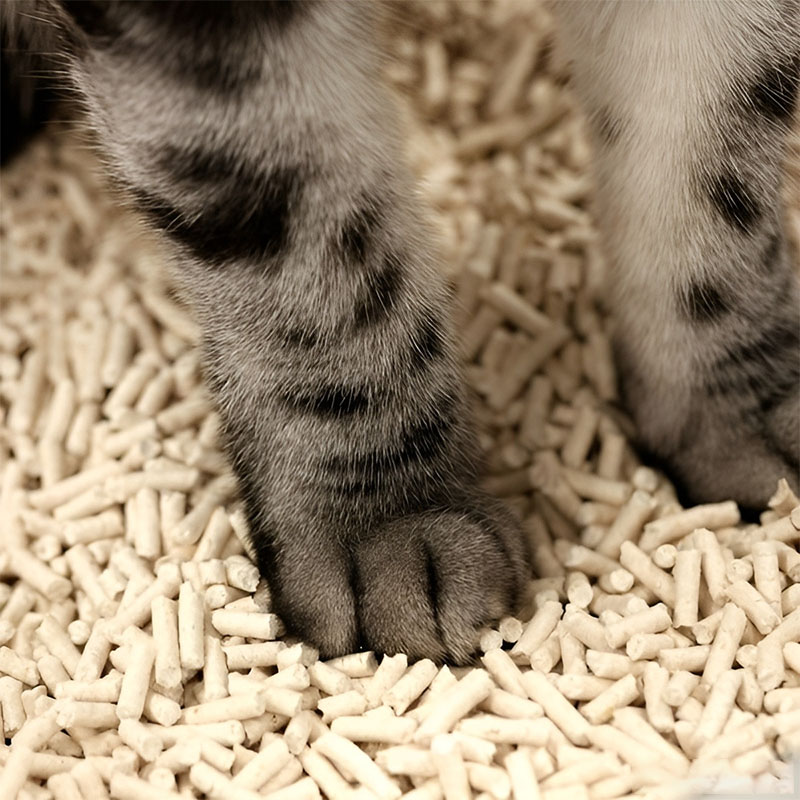
Ask how particle size and scent are handled. Aisha works with tofu granule sizes between 1.5 and 3.0 mm and offers customisable scent options (company-cited). When a buyer reports a cat reacting to litter dust, the practical answer is a lower-dust substrate plus better screening, not a new fragrance. Substrate choice also drives box acceptance — which is why litter-box guidance from welfare bodies such as the ASPCA matters for shelf sell-through.
2. Export Shelf-Life Testing: What a Cat Litter Supplier Must Prove
A six-week sea voyage exposes product to conditions a warehouse never sees. The production record should show a moisture target, sealed mixing that keeps batch composition stable, hot-air drying to a controlled water content, and vibration screening with dust extraction (company-cited). What you are buying is repeatability: every batch should clump the same way on day one and on day 300.
Ask for a storage-resistance test that cycles humidity and temperature, mimicking a humid port and a cold inland destination in one journey (company-cited). Then ask what the acceptance threshold is and who signs the COA.
3. Custom Packaging and Foreign-Language Labeling by a Cat Litter Supplier
Packaging is where a private-label programme either feels premium or looks improvised. Weighing, sealing, and labelling should run inline, with the ability to switch bag format, artwork, and foreign-language marking on the same line. Confirm that regulatory text can be printed in your market’s language and that pallet configuration is fixed in advance.
Buyers comparing the best cat tofu litter supplier options often find two factories quote the same product but very different packaging support. A vendor limited to stock or generic packaging is fine for a fast market test, but it will not build your brand. Request a free sample kit with finished retail bags to judge fill weight, seal quality, and artwork (company-cited).
4. Export Warehousing: How a Cat Litter Supplier Protects Moisture-Sensitive Stock
Finished goods can lose quality while they wait for a vessel, so a dedicated export warehouse should be ventilated, moisture-controlled, and separate from raw-material storage, with pallets off the floor to prevent wicking. Ask how long stock may sit before re-testing, and whether inventory is rotated by batch.
This matters most before peak season, when good suppliers hold stock for many customers at once. If your end users need handling guidance for soiled litter, the CDC’s toxoplasmosis overview is worth sharing with retail buyers.
5. Port Logistics: Why Dalian Port Lowers Landed Cost for a Cat Litter Supplier
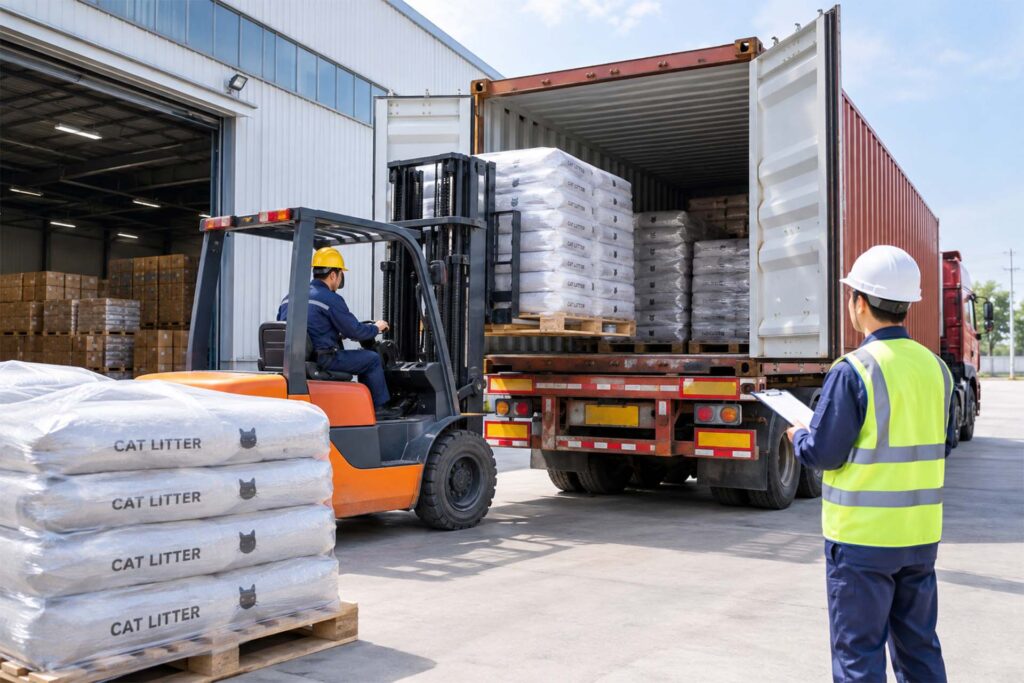
Port choice is a landed-cost decision disguised as a logistics detail: a factory close to Dalian port spends fewer hours on inland trucking, loads containers directly, and clears customs predictably. Ask how containers are consolidated, what the loading plan looks like, and how a rolled vessel is handled.
Lead times should be in writing and tied to a trigger event. As a reference point, Aisha quotes roughly 20 to 25 days for a first OEM order after artwork confirmation, and about 10 to 14 days for repeat orders (company-cited). Test that promise against the last three order timelines. For the paperwork side of moving product across borders, our cat litter export clearance guide walks through the documentation Aisha prepares for B2B shipments.
6. Cooperation Models: OEM, Bulk Purchase, and Cross-Border E-Commerce with a Cat Litter Supplier
One factory can serve you three ways, and the terms are not interchangeable. OEM and ODM private-label production gives packaging and formula control but requires tooling, artwork, and a longer first run. Bulk purchase in your own bags or unbranded sacks optimises unit cost for distributors. Cross-border e-commerce needs smaller, more frequent runs and a supplier willing to hold buffer stock.
Decide which model you are buying before you negotiate price, and test how flexible production scheduling really is: a supplier that can move your order by a week without destabilising the line is worth more than a marginally lower quotation. Our OEM cat litter manufacturer and factory guide breaks down MOQ, tooling, and lead-time trade-offs in more detail.
Which Cat Litter Supplier Fits Your Channel: Scenario Selection
Channel fit decides which weaknesses you can tolerate:
- Pet-chain importer: batch consistency, COA discipline, repeat lead time under three weeks.
- Private-label brand: formulation control, in-house artwork, comfort with ODM development.
- Cross-border e-commerce seller: small first runs, fast reorders, packaging that survives parcel handling.
- Institutional buyer (shelters, catteries, breeders): odour performance at high density and low-dust screening.
Importers searching for the best cat sand litter manufacturer are usually looking for this channel fit, and the answer differs by destination: a supplier optimised for supermarket volume in a temperate market is not automatically right for a humid, high-density buyer. For a step-by-step selection method, see how to pick a cat litter manufacturer for OEM/ODM.
Three Mistakes Importers Make When Choosing a Cat Litter Supplier
Mistake 1: Judging a Cat Litter Supplier by Capacity Numbers Alone
Headline tonnage tells you what a plant can do, not what it will do for you. A stated annual output of 300,000 tons (company-cited) is only meaningful next to batch size, quality-control staffing, and the number of customers already competing for the same line.
Be equally careful with sustainability language. If a supplier claims an eco-friendly or biodegradable product without test evidence, check the claim against the Guías Verdes de la FTC, which set expectations for environmental marketing in the United States.
Mistake 2: Letting a Cat Litter Supplier Skip Climate-Matched Formulation
Signing off on one blend for every destination is the most expensive shortcut in this category. Stock formulated for a dry market can arrive in a humid one already softening, and the complaint rate compounds with every pallet opened. Insist on destination-specific specifications, and write the climate assumptions into the purchase agreement so they can be tested on arrival.
Ask which variables will be adjusted: binder ratio, granule hardness, moisture ceiling, and dust-removal stages. A partner that explains these in engineering terms, rather than marketing terms, can also correct them when something goes wrong.
Mistake 3: Ignoring Packaging and Storage Discipline at a Cat Litter Supplier
Loose seals, thin film, and unpalletised cartons cause damage no formula can compensate for. Inspect the packaging line, not just the sample bag, and confirm finished goods are stored dry before loading. When moisture control fails, the symptom appears at the consumer end: a cat covered in dust from litter that has crumbled in the bag, followed by a return and a review that names your brand, not the factory’s.
Rigorous incoming and in-process checks are what keep this from happening — our standards and quality control in cat litter manufacturing article details the checkpoints Aisha uses on every line.
Storage and Incoming Checks Before You Release a Container
Before a container is released, run a short incoming checklist:
- Confirm the COA matches the shipped batch number and the agreed moisture ceiling.
- Weigh three sample bags per pallet against the specification.
- Squeeze-test a granule for hardness and check for fines at the bag base.
- Open the pallet wrap and feel for condensation on the inner film.
- Haz una foto del precinto del contenedor y de la etiqueta del lote antes de la salida.
Conclusion: How to Shortlist a Cat Litter Supplier
Shortlisting a cat litter supplier is less about finding the lowest quotation and more about proving the partner can repeat what it quoted — batch after batch, season after season, container after container. Score every candidate on the seven dimensions in the table above, insist on destination-specific formulation, and put lead times and climate assumptions in writing. The suppliers that survive that test are the ones worth a multi-year relationship.
Preguntas frecuentes
These are the questions importers ask most often when shortlisting a cat litter supplier.
Which documents should I request from a cat litter supplier before ordering?
A specification sheet, a COA for every batch, artwork proofs, a packaging mockup, and current certification evidence. Aisha holds BSCI tested, SGS certified, and ISO status (company-cited); you can verify social-compliance claims through the amfori BSCI framework and testing scope through SGS.
How long does a first OEM order take versus a repeat order?
Roughly 20 to 25 days after artwork confirmation on a first OEM run, and about 10 to 14 days on repeats once tooling and artwork are locked (company-cited). Treat the written lead time as a contract term, not a hope.
Can a cat litter supplier customise particle size, scent, and formula?
Yes, within limits. Aisha produces tofu granules between 1.5 and 3.0 mm, supports customised scent, and adjusts binder and moisture parameters by destination climate (company-cited). The right cat litter supplier treats these as engineering variables, not fixed catalogue items.
My customers say their cat is allergic to litter dust. What should I ask for?
Separate dust irritation from a true allergy. Dust and fragrance are common irritants, while the allergenic protein carried by cats themselves is the usual trigger for human symptoms, as the AAFA guidance on pet allergies explains. Request a lower-dust substrate and fragrance-free variants from your supplier.
How do I verify a product will survive a long sea voyage?
Require a storage-resistance test that cycles humidity and temperature, a fixed moisture specification, and a COA per batch (company-cited). For symptoms sometimes confused with product irritation, see the Mayo Clinic overview of pet allergy.
Can I order without my own brand artwork?
Yes. Many buyers start with stock packaging or generic packaging to test a market, then move to custom printed bags. Aisha runs its own brand portfolio alongside OEM private-label production, so one factory can support both stages (company-cited).
How much does port location affect landed cost?
More than most buyers expect. Shipping out of Dalian port shortens inland haulage and simplifies loading and customs declaration, which typically cuts freight spend and schedule risk on dense cargo such as litter.
 Spanish
  English
  Russian
  Japanese
  Arabic