Bentonite performance is inherited, not engineered. Bentonite Cat Litter Raw Materials determine the quality potential of the final product. A price per ton is a snapshot of a mined material, not a fixed recipe, and the decisions that shape a bag of granules happen before granulation: in the seam, the wash plant, the dryer, and the grading screen. Owners judge a container on the handful they pour, and when a cat avoids the box the first suspect is usually the box environment, not the cat.
This guide maps that system from the raw material side; see the bentonite cat litter product specifications for current program scope.
Who this guide is for: importers and private-label buyers choosing a cat bentonite litter manufacturer
For importers placing container orders, distributors re-supplying retail chains, and private-label or OEM buyers who want their own brand on the bag without inheriting someone else’s variance. Use it to fix a specification – feedstock, purification, drying, grading, dust, testing, traceability, storage – before the first purchase order. All figures are company-cited references; confirm them in writing.
主なポイント
- Feedstock beats machinery. Feedstock is the first variable: natural sodium bentonite from a stable mine source, checked for moisture and purity before acceptance (company-cited).
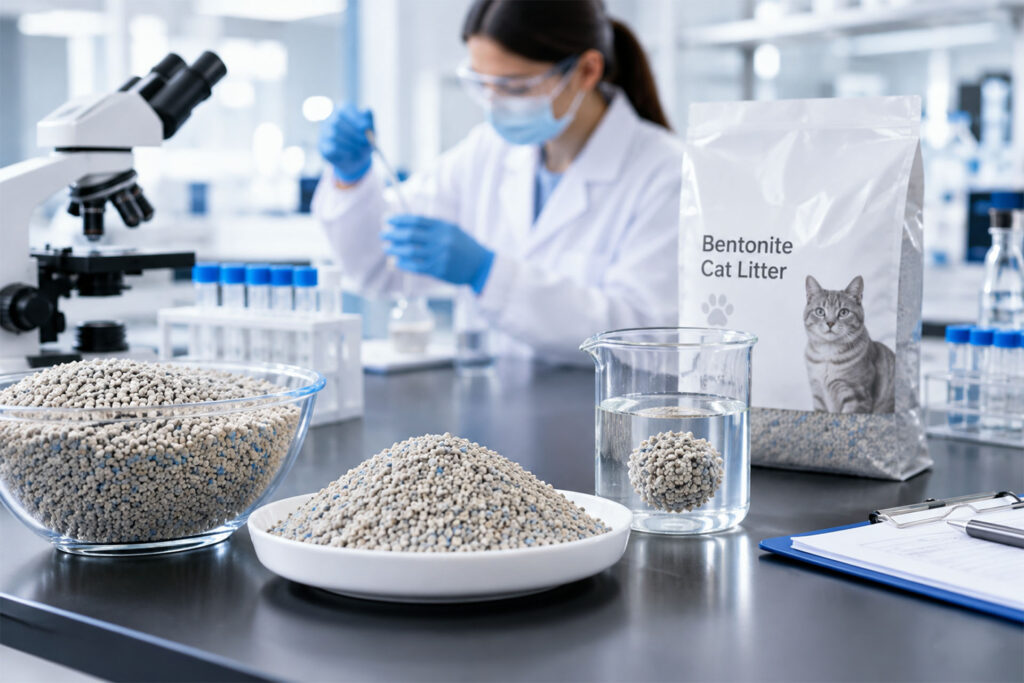
- Four lab checks. Four in-house lab checks do the work: raw material moisture and purity, liquid absorption, clumping and hardness, and dust and moisture caps (company-cited).
- Numbers to specify. Typical finished reference: 1-2 mm or 2-4 mm size, 0.8-0.9 g/cm3 bulk density, moisture under 8%, dust under 0.5%, absorption up to 300% of granule weight, 3-5 second clumping (company-cited; confirm in writing).
- Process is the lever. Purification, drying, and grading decide whether one seam yields a stable lot or a variable one.
- Dust is engineered. Multi-stage enclosed airflow dust extraction, automated batching, and batch control hold dust and ratios inside the agreed window (company-cited).
- Storage is part of QA. Raw clay in silos, finished goods in a warehouse kept off the floor and off the wall (company-cited).
- Traceability or it didn’t happen. Traceability is the insurance policy: lot codes, retained samples, a COA before loading, and a written path for off-spec lots.
Raw Material vs Finished Product: What a Manufacturer Tests
Most disputes come from testing the wrong thing at the wrong stage: a finished-goods test describes a result, a feedstock test prevents drift. Ranges below are company-cited; written specifications govern a shipment.
| ステージ | Check / parameter | Reference limit for planning (company-cited) | What drifts if it slips |
| Raw clay | Moisture and purity (in-house lab) | Lot-by-lot, limits set per mine source | Wet clay over-dries, dry clay dusts; grit reaches the bag |
| Raw clay | Sodium grade and montmorillonite content | Natural sodium bentonite, specified minimum | Slow, soft clumps; lower absorption |
| 製造 | Purity after washing and fines removal | Defined fines ceiling | Dust complaints; tracking on floors |
| Finished | 粒子径 | 1-2 mm or 2-4 mm | Screen separation; inconsistent clump feel |
| Finished | Bulk density | ~0.8-0.9 g/cm3 | Bag fill weight drift; dosing complaints |
| Finished | Moisture | Under 8% | Mold and caking during sea freight |
| Finished | ほこり | Under 0.5% | Airborne dust at the box; retail returns |
| Finished | Water absorption and clumping | Up to 300% of own weight; 3-5 seconds | Soft clumps, sticky bottom, faster litter changes |
How a Bentonite Cat Litter Manufacturer Selects Natural Sodium Bentonite Feedstock
Sodium bentonite swells and binds water; calcium-dominant clay does far less of both, so the first question is about the seam, not the machine.
Three feedstock controls that matter
- Clay from a known seam, checked for moisture and purity before acceptance – the raw-material half of the in-house lab program.
- Admission testing with retained samples, so a complaint months later traces to one delivery.
- Silo storage off the floor and off the wall (company-cited).
This is where bentonite cat litter raw materials suppliers separate. Ask which mines feed the line, whether the grade is natural sodium, and how a seam change is communicated.
Purification, Drying, and Particle Grading
Purification is what makes raw clay acceptable in a home: washing and fines removal take out grit, quartz, and the ultrafine fraction that becomes airborne dust the moment a bag is poured.
Washing and fines removal
Unrefined, unwashed clay carries grit, uneven particle size, and a fines fraction that becomes airborne dust the moment the bag opens. Washing sets the fines ceiling that your dust figure depends on.
Drying as the underrated control
Drying is the most underrated control point. Moisture above the ceiling invites mold and caking on a long sea leg; over-drying makes granules brittle, and brittle granules turn into dust. The reference ceiling of under 8% protects both ends (company-cited).
Grading and bulk density
Grading follows: standard sizes are 1-2 mm and 2-4 mm with a controlled fines fraction, and bulk density near 0.8-0.9 g/cm3 follows from those choices (company-cited). Automated batching then keeps blend ratios identical shift to shift (company-cited). Not all bentonite cat litter manufacturers hold that discipline, and when it drifts the symptom appears at your warehouse, not in the quotation.
Dust, Additives, and Odor Control in Raw Materials
Dust begins at the mine as fines and ends wherever air handling releases it. Multi-stage enclosed airflow dust extraction is the reference answer: enclosed stages that pull fines out at transfer points instead of letting them settle back into the product (company-cited).
Enclosed airflow dust extraction
Enclosed stages pull fines out at transfer points rather than letting them settle back into the product. It is the single biggest difference between a low-dust line and a dusty one.
Additive drift and dosing
Additives are the second source of drift. Activated carbon and fragrance serve odor performance, and dust suppressants hold fines down – each trades against something. An over-dosed suppressant slows water uptake and softens clumps; an uncontrolled fragrance ratio makes one lot smell unlike the next. Automated batching keeps those ratios in the agreed window (company-cited). For indoor dust as a general topic, the
Additives are the second source of drift. Activated carbon and fragrance serve odor performance, and dust suppressants hold fines down – each trades against something. An over-dosed suppressant slows water uptake and softens clumps; an uncontrolled fragrance ratio makes one lot smell unlike the next. Automated batching keeps those ratios in the agreed window (company-cited). For indoor dust as a general topic, the EPA guidance on indoor air quality is a useful reference for retail partners.
COA, In-Transit, and Batch Traceability
A certificate of analysis only helps if it is lot-specific, complete, and issued at the right moment.
COA before loading
The working standard is a COA before container loading (company-cited): by the time the container is sealed, you know the moisture, dust, absorption, and clumping results of the material inside it. Independent laboratories such as SGS can re-run agreed parameters when your market needs accredited documentation.
Traceability as insurance
Traceability separates a claim from a guarantee. A bag lot code should resolve to the raw clay delivery, the production date and line, and the retained lab sample, so a complaint about soft clumps can be investigated instead of argued about. A workable sequence: re-test the retained sample, establish whether drift came from feedstock, drying, or dosing, then decide on rework, credit, or replacement.
In-transit protection
In-transit protection is mostly about water: liner bags, sealed units, and a moisture ceiling low enough to survive weeks of temperature swings. Below 8% is the company-cited reference and belongs in your specification, together with the retained-sample reference for each lot.
Auditing a Manufacturer: Sampling and Arrival Re-Tests
A factory audit is not a facility tour. Follow the material flow and check four things: storage keeping raw clay and finished goods off the floor and off the wall; an enclosed multi-stage dust system at every transfer point; an in-house lab that actually runs the four test capabilities; and batch records linking a bag to a date and a line (company-cited). Social compliance records from amfori BSCI audits cover the labour and ethics side retail buyers require.
Agree the sampling method
Agree in advance how samples are drawn – from which bags, at which depth, with which tool – so both sides describe the same material. On arrival, re-test what drives complaints: dust, moisture, particle size distribution, clumping speed and hardness. Treat the COA as the expected value and your re-test as the verdict; for staff handling damaged bags or returns, the
Agree in advance how samples are drawn – from which bags, at which depth, with which tool – so both sides describe the same material. On arrival, re-test what drives complaints: dust, moisture, particle size distribution, clumping speed and hardness. Treat the COA as the expected value and your re-test as the verdict; for staff handling damaged bags or returns, the CDC overview of toxoplasmosis is a practical hygiene reference.
Refined vs Raw Clay: What ‘Purified’ Means
Cheap clay is not a discount; it transfers cost from the supplier to your complaint inbox. Unrefined, unwashed clay carries grit, uneven particle size, and a fines fraction that becomes airborne dust the moment the bag opens.
Use specific buying language with any bentonite cat litter factory. Ask for the purification route: is the clay washed, and to what fines ceiling? Ask for grading by screen size, the dust figure, and the moisture ceiling, and whether those are measured in-house or verified by a third party. Then ask what changes in the price when the dust figure drops – a supplier who answers is pricing a process, not a pile of dirt. If your program also competes on odor, those levers are examined in the
Use specific buying language with any bentonite cat litter factory. Ask for the purification route: is the clay washed, and to what fines ceiling? Ask for grading by screen size, the dust figure, and the moisture ceiling, and whether those are measured in-house or verified by a third party. Then ask what changes in the price when the dust figure drops – a supplier who answers is pricing a process, not a pile of dirt. If your program also competes on odor, those levers are examined in the B2B sourcing guide for odor control.
Three Mistakes That Undermine Batch Consistency
Mistake 1: Choosing a manufacturer on price per ton alone
The cheapest landed ton is usually the least controlled ton. A quote far below market takes its saving out of purification, dust extraction, or drying time – the steps your customer notices. Fix the specification first: purity and fines ceiling, dust and moisture maximums, particle size distribution, absorption, clumping time. For private-label programs, an
The cheapest landed ton is usually the least controlled ton. A quote far below market takes its saving out of purification, dust extraction, or drying time – the steps your customer notices. Fix the specification first: purity and fines ceiling, dust and moisture maximums, particle size distribution, absorption, clumping time. For private-label programs, an OEM bentonite cat litter manufacturer should price a process, not a pile of dirt.
Mistake 2: Treating the COA as proof of delivery
A COA describes a production lot; it does not prove the right lot was loaded. Buyers get caught when bag lot codes do not match the certificate, when the certificate covers raw material but not finished granules, or when one certificate is reused across runs. Match lot codes before unloading and keep a retained sample from each container.
Mistake 3: Ignoring how clay and finished goods are stored
Storage settles the arguments that production started. Bags on bare concrete or flush against an external wall draw moisture, and moisture inside a sealed pallet is how mold and caking begin in a humid market. Raw clay belongs in silos off the floor and off the wall, and finished goods need the same discipline plus first-in-first-out rotation (company-cited).
Storage and Incoming Checks at the Warehouse
Put storage rules in the purchase contract: raw clay in silos clear of floor and wall, finished pallets on racking in a dry warehouse with FIFO rotation (company-cited). Keep incoming pallets off the floor and rotate by lot rather than convenience.
Incoming checklist
- Match bag lot codes to the COA.
- Check liner integrity and seals.
- Pull a retained sample into a marked container; keep samples for the shelf life plus a margin – the first comparison in any dispute is the bag a customer opened versus the sample you kept.
Conclusion: How to Vet a Manufacturer Before You Reorder
Batch consistency is a chain: a stable seam, admission testing, real purification, controlled drying, disciplined grading, enclosed dust capture, measured additives, in-house lab checks, and documentation that travels with the lot. Break one link and the failure surfaces at retail, as dust, weak clumps, or a moldy pallet after a long sea leg.
Fix the specification in writing, request a sample lot and the current COA to request a sample lot and the current COA, tour the plant and warehouse, and agree the sampling method and off-spec path before the first order.
よくある質問
Practical questions on bentonite cat litter raw materials and the controls that keep a private-label or OEM program consistent from one container to the next.
同じサプライヤーからの2つのロット間で、凝集性や粉塵の量がなぜ異なるのでしょうか?
Because bentonite cat litter raw materials are mined clay, not a fixed formula. Moisture and mineral grade shift by delivery, so drying, grading, and dosing must compensate every shift. Admission testing, retained samples, and batch control narrow the swing – but only a manufacturer that actually runs them keeps two containers behaving like the same product.
ベントナイト製猫用トイレ砂のメーカーには、まずどのような原料に関する質問をすべきでしょうか?
その生産ラインで天然のナトリウムベントナイトを使用しているか、指定されているモンモリロナイトの範囲はどの程度か、また原料は1つの安定した鉱脈から供給されているのか、それとも複数の鉱脈から供給されているのかを確認してください。ナトリウム含有量は膨潤性と凝集強度に影響するため、価格について話し合う前に、これらのベントナイト猫砂原料に関する質問の答えによって、小売業者に約束できる性能が決まります。.
発注する前に、書面による仕様書にはどのような制限事項を盛り込むべきでしょうか?
At minimum: particle size (1-2 mm or 2-4 mm), bulk density near 0.8-0.9 g/cm3, moisture under 8%, dust under 0.5%, absorption up to 300% of granule weight, and clumping in 3-5 seconds. Put these bentonite cat litter raw materials limits in the contract so a shipment is judged against your numbers, not the supplier’s.
COAはいつ発行すべきか、またその内容はどのようなものでなければならないか。
コンテナへの積み込み前に、完成品ごとにロットごとの検査を行う必要があります。検査項目には、水分、粉塵、吸水性、凝集性、硬度、および粒度分布を含める必要があります。ベントナイト製猫用トイレ砂の原材料は納入ごとにばらつきがあるため、積み込み前の証明書を作成することで、既知の数値を明記し、規格外ロットが倉庫に届く前に受け入れを拒否することができます。.
自社に検査室がない場合、原材料の管理をどのように監査すればよいでしょうか?
材料の流れを追跡してください:床や壁から離して設置されたサイロ貯蔵、密閉型の多段式集塵装置、保存期間を明記した保存サンプル、製品と製造ラインおよび製造日を結びつけるバッチ記録、そして4つの検査を実施する社内検査室。ベントナイト製猫用トイレ砂の原材料を自社で検証できない場合でも、こうした目に見える管理体制によって、そのシステムが本物かどうかを見極めることができます。.
What is the correct process if an arriving lot fails our re-test?
Stop the release, compare your result with the retained sample and the COA, and notify the supplier with the lot code. Work the pre-agreed path: re-test, root-cause on feedstock, drying, and dosing, then rework, credit, or replacement. Treat bentonite cat litter raw materials variance as a process fault, not a one-off.
How do MOQ, tooling, and repeat orders usually work for OEM bentonite cat litter?
Programs commonly run flexible MOQ, packaging in 5 L, 10 L, 15 L, and 25 L bags or custom formats, first OEM tooling in about 20-25 days, and repeat production in 10-14 days. Because bentonite cat litter raw materials need a stable spec, confirm the schedule and the off-spec path in writing before the first order.
 Japanese
 English
 Spanish
 Russian
 Arabic