Bentonite is the most mispriced line on the pet shelf. Assortments still carry a story written twenty years ago, when mineral litter meant dusty bags, uneven grit, and a plain look, so buyers learned to treat the category defensively against plant-based brands sold on fragrance, colour, and packaging. That story no longer matches the specifications, and the gap between reputation and product is where reorder margin is being left on the table.
The problem is structural: retail plans were rebuilt around packaging claims, so nobody re-specified the mineral line while producers of premium cat bentonite litter moved to washed, dried, screened, and polished granules that behave nothing like the raw clay the category is still judged on.
このガイドの対象読者
For importers, distributors, wholesalers, private-label brands, and retail buyers who already sell litter and need a defensible purchasing position on the mineral side of the category. If your shelf still treats bentonite as the cheap filler under a plant-based hero SKU, this guide shows where the specification — not the price tag — actually earns margin.
主なポイント
- The low-end label describes early raw clay stock, not today’s refined premium cat bentonite litter.
- Clump strength and load tolerance separate a reorder product from a complaint product.
- Micro-porous odour adsorption behaves differently from fragrance masking, most visibly in closed rooms.
- Texture and dryness drive box compliance more reliably than price does.
- Tracking, dust, and disposal belong in written acceptance criteria, not in marketing copy.
- Specify particle size, hardness, moisture, dust rate, absorption, and clump speed — six numbers per batch.
- A 7:3 mineral-plus-tofu combination supports a price ladder without losing volume buyers.
Premium Cat Bentonite Litter: Refined vs Raw Stock at a Glance
Treat the comparison below as a specification sheet, not a slogan. Two containers of the same category can differ on every row.
| Procurement Dimension | Raw Bulk Clay Stock | Refined Programme Stock |
| Particle size distribution | Wide spread, grit and stones present | Narrow band, screened and polished |
| Clump integrity under load | Crumbles, layers, or sticks to the base | Holds shape, releases cleanly |
| Moisture at packing | Variable, rarely stated | Fixed target with batch record |
| Dust rate | High and inconsistent | Low, measured at pouring |
| Absorption and clump speed | Slow, uneven across the tray | Fast and repeatable batch to batch |
| Odour mechanism | None, relies on masking later | Micro-porous adsorption of ammonia |
| Tracking tendency | High fines fraction tracks further | Low fines fraction, easier to contain |
| Cost position | Lowest invoice, highest complaint cost | Priced on specification, not weight |
| Typical channel | Discount and clearance volume | Supermarket, pet specialty, private label |
Where the Low-End Reputation Came From
The reputation is a residue of the early trade. Low entry barriers meant operators mined raw clay and packed it almost as it came out of the ground, with no purification, dust removal, or screening: grit and stones in the bag, clumps that broke apart, product stuck to box bases. Buyers who learned the category then still describe it that way, and in several markets the search phrase is still ‘cat sand litter’, a legacy term that frames an engineered absorbent as playground sand.
Plant-based and crystal formats then took the premium narrative with cleaner visuals and heavier marketing, and bentonite drifted to the bottom of the assortment plan. What never happened was a re-specification.
What Refined Processing Changed in Premium Cat Bentonite Litter
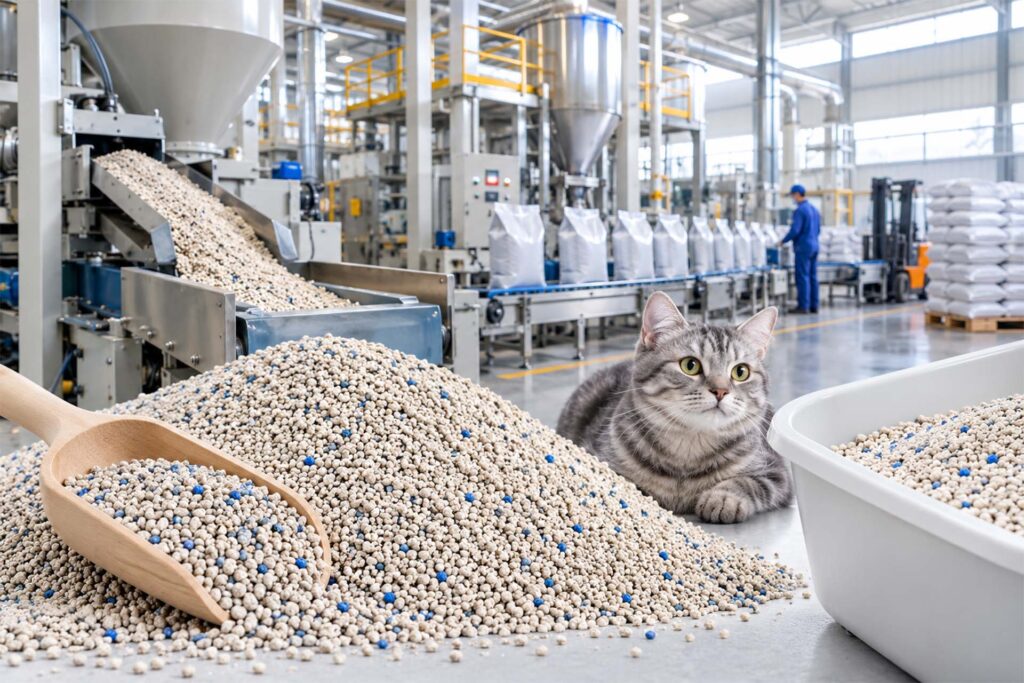
Water washing strips fines, quartz fragments, and organic matter from the clay body. High-temperature drying brings water content to a controlled target, which gives granules hardness instead of a crumbly shell. Multi-stage dust removal, using extraction, cyclones, and vibration screening, pulls the fine fraction out before packing. Particle polishing rounds the edges so granules abrade less in the bag, which is the hidden source of dust that appears on a customer’s floor rather than at your dock.
The result is a narrower particle size band, a measurable dust rate at pouring, repeatable clump strength, and odour control from the mineral’s own micro-porous structure, which makes premium cat bentonite litter a different purchase from raw bulk stock sold under the same category name. Ask suppliers for engineering answers rather than marketing ones: how many dust-extraction stages, what moisture target at packing, and which hardness method on what sample size. Aisha runs bentonite OEM and ODM programmes covering custom formula, fragrance, particle size such as 1.5 to 3.0 mm for tofu formats, activated carbon or deodorizing beads, packaging design, private label, and flexible MOQ (company-cited).
Why Cats Choose Premium Cat Bentonite Litter: Instinct and Acceptance
Cats evolved to eliminate on soft, dry, diggable ground, and a fine bentonite granule is the closest commercial match to that substrate. That is why a cat won’t use non-absorbent litter that leaves liquid pooling at the tray base: the surface never feels dry, odour builds, and the animal looks for another surface in the house. The same logic runs through litter training, where texture, depth, and cleanliness decide compliance long before any reward-based method does.
The ASPCA’s guidance on litter box problems lists litter preference or aversion among the most common reasons cats eliminate outside the box, and notes that most cats prefer clumping litter with a medium to fine texture at a shallow depth. Texture is therefore a functional requirement, not a cosmetic detail, and catteries and multi-cat homes remain the most reliable buyers of premium cat bentonite litter because they need one base product that every animal accepts. Expect a transition window of a few days when converting a household from a coarse or strongly scented substrate.
Three Hard Strengths of Premium Cat Bentonite Litter
Clumping That Holds Under Load
A refined granule collapses inward on contact with liquid, binds into a compact mass, and holds its shape when the scoop lifts it. A clump that survives lifting keeps the tray base dry, so customers change litter at the intended interval instead of scrubbing the box, and a clean clump lets the owner track urine volume, the earliest visible signal of urinary problems. Ask for a standardised absorption and clump-speed figure, then run your own lift test at thirty seconds and five minutes.
Micro-Porous Odour Control Instead of Fragrance Masking
Perfume layers a scent over ammonia, which in a closed apartment combines into something worse and fades within hours. A refined granule adsorbs odour molecules into its micro-porous structure, so odour is reduced rather than covered. The practical signature: it still controls a tray left unscooped overnight and does not smell sweet in the bag. For fragrance-sensitive markets, a fragrance-free mineral line removes an entire class of complaints without reformulation.
Moisture Tolerance and Shelf Resilience
Bentonite does not mould or soften the way starch-based granules can when humidity rises, so stock survives a damp corner and a slow-moving pallet keeps its usable window. Add a moisture ceiling to the specification and verify it on arrival: a bag that has absorbed water in transit arrives heavier, dustier, and slower to clump, and that failure gets blamed on the brand.
Honest Limitations of Premium Cat Bentonite Litter, and How to Buy Around Them
Tracking Is Real, so Design for It
Fine granules lodge in paw pads and travel out of the box. The remedy is operational, so bundle a tracking mat where regulations allow, design tray entry height into the display plan, and state the expected tracking range on the pack.
Dust Is a Specification Issue, not a Category Flaw
Raw stock without dust removal produces airborne fines; refined grades do not, but the difference has to be written into the contract. Set a dust-rate ceiling at pouring, reference the test method, and hold a failing batch. The EPA particulate matter overview is a useful reference when explaining to retail partners why fine airborne particles are a quality concern rather than an aesthetic one. Disposal is the third constraint: granules are not flushable, so the product needs clear waste instructions and packaging that makes bagging easy.
Disposal Belongs in the Acceptance Criteria
Granules are not flushable, and a vague ‘bag and bin’ line on the pack reads as an afterthought. Write the waste instruction into the same document as the specification so the quality team and the packaging team are working from one brief.
Selecting Premium Cat Bentonite Litter by Channel, Climate, and Format
By Channel
Channels want different specifications. Discount and hypermarket volume needs a consistent mid-band granule at the lowest defensible cost; pet specialty needs a narrow, polished granule with a low dust rate, sold with a tracking mat; private label needs formula and packaging control plus a factory that can hold a specification across reorders; institutional buyers buy on odour performance at high density and on the absence of fines.
By Climate
Climate should drive the brief too: humid coastal markets prioritise moisture resistance and odour control, dry inland markets prioritise dust reduction, and high-density cities prioritise clump strength because trays are scooped less often. One blend for all three is the most common sourcing shortcut, and it shows up later as regional complaint clusters.
By Format
Format is where margin is decided. A 7:3 mineral-and-tofu combination puts a clumping mineral base under a tofu top layer that cuts tracking and dust and gives the pack a cleaner visual. Sold as a bundle or a dual-channel assortment, it holds a premium price without giving up the volume buyer. When you position either format against plant-based claims, keep the language factual and testable, because the FTC Green Guides set the expectations for environmental marketing in the United States. For the European retail and institutional channel, the FEDIAF guidelines set the expectations buyers plan around.
Three Mistakes When Specifying Premium Cat Bentonite Litter
Mistake 1: Specifying on Invoice Price Alone
Price per ton compares weight, not performance. A low-dust, hard, evenly sized granule costs more up front and delivers a lower cost per scooped clump, fewer returns, and higher reorders. Buy on cost per use and put the six drivers in the specification: particle size band, hardness, moisture ceiling, dust rate, absorption, and clump speed.
Mistake 2: Treating Dust as Unavoidable
Buyers burned by raw stock often conclude that all mineral litter is dusty, then abandon the category instead of tightening the specification. Dust is a process outcome: washing, drying control, staged dust removal, and polishing determine it, and a supplier that can describe those stages can be held to a numeric ceiling. Define the test, accept or reject each shipment against it, and the objection leaves your reviews.
Mistake 3: Pricing It Only as a Value Line
If the mineral line sits permanently below the plant-based line, customers read it as inferior and the format loses its ladder. Position refined mineral stock as the performance base of the shelf with a specification-led price, and use the bundled 7:3 combination as the premium step. Leave the entry price point to raw bulk stock that you buy deliberately or decline.
Storage and Incoming Checks
- Confirm the COA matches the batch number and the agreed moisture ceiling.
- Verify the four pre-shipment COA values: moisture, clumping, dust, and absorption.
- Weigh three sample bags per pallet against the specified fill weight.
- Squeeze a granule for hardness and check for fines at the bag base.
- Pour a sample from waist height and look for visible dust.
- 出荷前に、コンテナの封印部分とロットラベルを撮影してください。.
Conclusion: Making Premium Cat Bentonite Litter Work on Your Shelf
The category has already been re-engineered; the buying brief has not. Rebuild it around six measurable values, test clump strength and dust yourself, price the refined line as the performance base of the shelf, and use the 7:3 mineral-and-tofu combination as your premium step.
To move from argument to specification, start with a factory-level conversation. Review the bentonite litter programme for current formats and OEM capability, then contact Aisha for a sample kit, a specification sheet, and a written lead-time commitment for your destination market.
よくある質問
Practical questions from distributors and private-label buyers specifying premium cat bentonite litter for the first time.
What belongs in a specification sheet for premium cat bentonite litter?
Six numbers, each with its test method and acceptance threshold: particle size band, granule hardness, moisture at packing, dust rate at pouring, absorption, and clump speed. Aisha issues a COA before shipment covering moisture, clumping, dust, and absorption (company-cited), which supplies four of the six on every batch.
How much dust should I accept in premium cat bentonite litter?
Set a ceiling you can defend, not a marketing claim. Ask how many dust-removal stages the line uses, request a pour test, and reject batches above the agreed rate. Low dust is a process capability, not a property of the category name, and a measured dust rate at pouring is what separates refined stock from raw clay.
Why does premium cat bentonite litter still track?
Fine granules lodge in paw pads and travel a short distance from the tray. The answer is a tracking mat, correct tray sizing, and honest pack communication rather than a change of granule, so specify the expected tracking range and design the display around it.
Can cat litter make my cat sick?
A quality mineral substrate is not a documented illness source, but two points deserve attention. Litter left damp and dirty can irritate skin and airways, and boxes are a hygiene point: the CDC’s toxoplasmosis overview recommends daily litter box cleaning. Human respiratory symptoms such as sneezing and wheezing are usually driven by the cat’s own dander rather than the granules, as the Mayo Clinic overview of pet allergy and the AAFA guide to pet allergies explain.
Which certifications should I verify before ordering premium cat bentonite litter?
Confirm social compliance and product testing separately. Aisha holds ISO and BSCI certified factory status with BSCI tested and SGS certified programmes (company-cited); check social-compliance claims against the amfori BSCI framework and testing scope with SGS. Ask for current certificate numbers, not logos.
How do I structure a first order of premium cat bentonite litter?
Start with stock packaging or generic packaging to test the market, then move to private label once reorder data is clear. Aisha quotes roughly 20 to 25 days for a first OEM order after artwork confirmation and about 10 to 14 days for repeats (company-cited). Order a sample kit, run your own pour and clump tests, and agree the specification before tooling begins.
Does particle size change the buying decision?
Yes. A narrower band pours more evenly, tracks less, and clumps more consistently. Aisha produces tofu granule sizes between 1.5 and 3.0 mm and supports customised scent, activated carbon or deodorizing beads, and packaging design across OEM and ODM programmes with flexible MOQ (company-cited).
 Japanese
  English
  Spanish
  Russian
  Arabic