主なポイント
- Tofu pellets are built from pea fiber, starch, and 1-2% guar gum, so incoming material specs control most of the finished quality.
- Diameter is customizable between 1.5 mm and 3.0 mm, and length is tuned for clump speed, tracking, and tray acceptance.
- Aisha runs automated batching, multi-stage enclosed air dust extraction, and an in-house lab from a 60,000 m² plant near Dalian port (company-cited).
- The lab tests raw material moisture and purity, liquid absorption, clump strength and hardness, plus dust and moisture ceilings that guard against mold at sea.
- A COA is issued before container loading; repeat orders typically ship in 10-14 days, first private-label orders in 20-25 days.
- MOQ is flexible, and a sample box covering tofu, bentonite, mineral, and pine can be sent before you commit.
- Biodegradable is not the same as flushable, so label claims must respect local disposal rules.
Inside a Cat Tofu Litter Factory Line: From Mixing to Auto Bagging
The production sequence, step by step
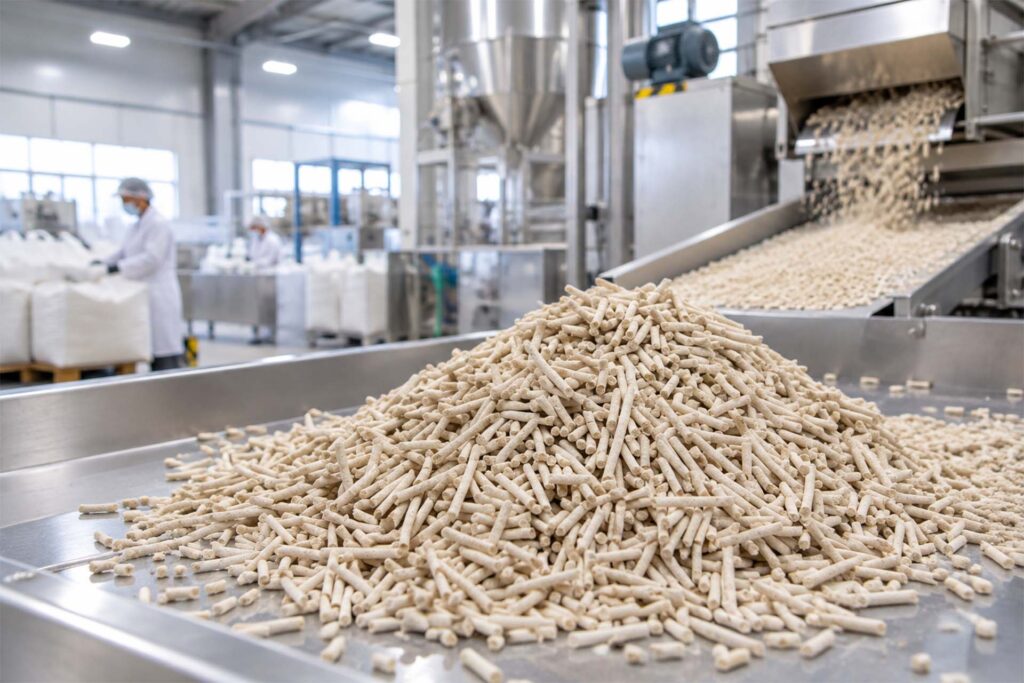
Commercial production follows a fixed sequence: raw material intake, mixing, extrusion, drying, cooling, sieving, and bagging, then lab release and COA. What separates plants is not the sequence — every line runs the same eight steps — but how tightly each stage is documented. The table maps each step to its control point and the test that proves it.
| Process step | Key control point | Outbound check |
| Raw material intake | Pea fiber and starch screened for moisture, purity, and foreign matter; guar gum held at 1-2% | Raw material moisture and purity |
| Mixing and batching | Automated dosing keeps the fiber, starch, and gum ratio identical per lot | Batch record and clump speed trial |
| Extrusion and granulation | Low-temperature forming at controlled pressure keeps pellets intact | Pellet hardness and breakage rate |
| 熱風乾燥 | Gentle air at a set temperature removes free water without scorching fiber | Moisture ceiling |
| 冷却 | Pellets rest before bagging so residual heat cannot create condensation | Moisture and temperature at bagging |
| Sieving and dust extraction | Multi-stage enclosed air separation removes fines and powder | Dust ceiling |
| Fragrance coating | Light coating only, since scent must not mask a raw material fault | Odor panel check |
| Automatic bagging | Weight, seal, batch code, and date printed inline | Seal and label audit |
| Lab release and COA | Full test set run on the retained sample before loading | COA attached to the shipment |
What each stage controls
Automated batching decides the ratio, extrusion sets pellet density, drying removes the water that would otherwise feed mold, cooling stops condensation inside the bag, and sieving with enclosed air extraction cuts fines while capturing dust instead of redistributing it. Fragrance coating stays light — scent must not mask a raw material fault. Weight, seal, batch code, and date print inline at bagging, so a bag on a shelf in Hamburg can be traced back to a mixer in Dalian.
Raw Materials: Pea Fiber, Starch, and Guar Gum
What each input does
A pellet is only as good as what enters the mixer. Three inputs do the work: pea fiber supplies structure and the natural clumping behavior; starch binds and helps the pellet hold its shape; guar gum at roughly 1-2% of the blend fine-tunes how fast and how firm the pellet sets once wet. Because the recipe is short, incoming quality has nowhere to hide: fiber that arrives damp, dusty, or mixed with husk shows up later as weak clumps and extra fines.
Intake inspection and rejection records
Intake inspection comes first. Every delivery is checked for color, moisture, purity, and foreign matter, and rejected material never reaches the silo. Ask how the plant documents those rejections — the answer tells you whether the spec sheet is enforced or decorative.
Pellet Size and Length a Cat Tofu Litter Factory Can Customize
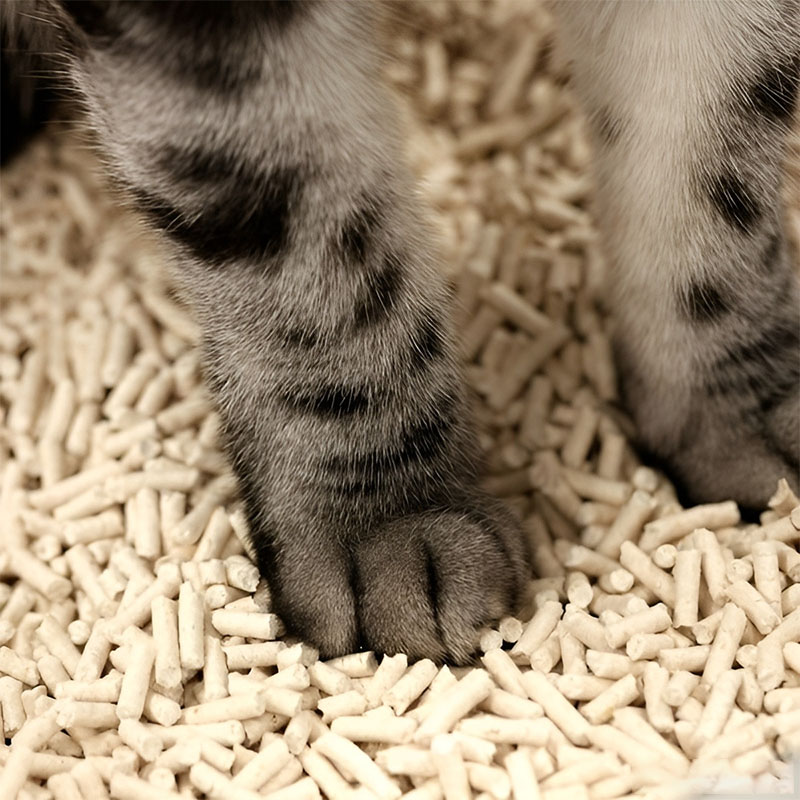
Standard diameter runs from 1.5 mm to 3.0 mm, and length is adjustable to the channel. Smaller, shorter pellets clump faster and feel softer under a paw, but they track more on long fur and lodge in tray corners. Larger, longer pellets track less and last longer, yet need slightly more moisture contact before the clump locks. A supplier that holds both ends of that range without altering the recipe is stronger than one quoting a single size. If your inbox fills with questions about a cat eating tofu litter, pellet hardness and a clean, food-grade input list are the details to confirm with the plant. Review the standard tofu litter range before locking a size.
Moisture Control for Ocean Transit
Mold is the most expensive failure here, because one affected container can end a listing. Moisture has to be managed at three points: the raw material, the pellet leaving the dryer, and the sealed bag. Gentle hot-air drying lowers water content without scorching the fiber, but pellets must also cool before bagging or residual heat becomes condensation inside the liner. Packing pattern, pallet spacing, and container ventilation finish the work. Ask which moisture ceiling a plant guarantees at loading, and whether it appears on the COA.
Outbound Testing and the COA You Receive
Every lot should clear four test families before release: raw material moisture and purity, liquid absorption, clump strength and hardness, and dust plus moisture ceilings. Absorption shows how much liquid a fixed weight of pellets holds. Clump and hardness trials show whether a wet clump survives scooping or breaks on the way to the bin. Dust limits protect airways in closed rooms, which is why the EPA guidance on indoor air quality is worth reading before you promise a low-dust benefit. Ask for the COA that ships with your container and check that the batch code on the bag matches it.
Tofu Pellets Beside Bentonite: Channel and Price Fit
Clumping clay still dominates volume channels: it is heavy, inexpensive per kilogram at the low end, and widely accepted. Plant-fiber pellets compete on different ground: lighter bags, tighter odor control with carbon or fragrance options, natural color, and a compostable end of life that fits markets with strict waste rules. For the European angle, FEDIAF frames how the pet-food industry reads environmental credentials. A fuller bentonite vs tofu sourcing comparison is on the site if you are weighing both lines.
Table 1. Tofu pellets vs clumping bentonite at a glance.
| Buying question | Tofu pellets (plant fiber) | Clumping bentonite |
| Freight and density | Light bags; volume-loaded pallets travel further per container | Heavy; freight cost rides with weight density |
| Price position | Higher per liter; premium and eco-positioned channels | Inexpensive per kilogram at the low end; bulk volume |
| 防臭・消臭 | Tighter with carbon or light fragrance coating | The volume-channel standard, widely accepted |
| End of life | Compostable under the right conditions; not flushable | Mineral waste; no compostable claim |
| Best-fit channel | Premium grocery, pet specialty, e-commerce subscription, eco private label | Price-driven bulk programs and volume retail |
Packaging, MOQ, and Lead Times
Standard pack sizes are 5 L, 10 L, 15 L, and 25 L, plus custom formats for private label. Because the product is light, freight economics favor volume-loaded bags and tight pallet patterns, and both plastic-lined paper and PE bags work if the seal holds and the moisture ceiling is respected. First orders that need printing plates take 20-25 days, while repeat orders usually ship in 10-14 days. MOQ is flexible, and a sample box covering tofu, bentonite, mineral, and pine options can be sent before you commit.
Choosing and Auditing a Cat Tofu Litter Factory
Five questions for a plant visit
Ask for the batching record of a lot you can identify by code. Ask which moisture ceiling applies at loading and how it is measured. Ask how many dust stages the enclosed air system has and where the fines end up. Ask what share of output is rejected in a quarter. Ask for the retained-sample library and the rejection log. A plant that answers with documents rather than adjectives is the one to shortlist, because the best cat tofu litter factory for your program is the one whose weakest lot still meets spec.
On site: the walk-through
Walk the intake area first, then the mixing floor, the dryer, the sieving line, and the finished-goods warehouse. Confirm that dust equipment runs during your visit, that silos and finished bins are labeled by lot, and that the lab keeps retained samples. Ask for SGS certification evidence and an amfori BSCI audit trail rather than a logo on a catalog page; the EU REACH and LatAm import certification page lists what to keep on file for market entry.
On arrival: receiving checks
Verify the container seal, weigh a few bags, open one bag per pallet row, screen for fines, test a clump yourself, and match the batch code to the COA before signing the receipt.
In your warehouse: storage rules
Keep pallets off bare concrete and away from exterior walls, hold stock in a dry, ventilated area, leave bags sealed until use, rotate by lot, and never stack to heights that crush pellets into fines. Any smell of damp cardboard or a musty note is a reason to quarantine the pallet and test before selling.
Three Mistakes That Sink Tofu Litter Programs
Mistake 1: Assuming every factory runs the same recipe
Pea fiber, starch, and guar gum appear on almost every spec sheet, which makes production lines look interchangeable. They are not. Fiber source, starch type, the exact guar gum share inside the 1-2% band, and extrusion pressure all shift how a pellet absorbs and clumps. Two approved-looking plants can ship pellets that behave like different products. Benchmark samples side by side under identical tray conditions before signing a long-term price agreement.
Mistake 2: Choosing on a single good sample
One beautiful sample proves nothing about lot consistency. Batch discipline is what a buyer actually purchases: automated dosing, one recipe per SKU, retained samples, and rejection records. Ask for three lots produced in different months and compare clump speed, dust, and smell. This is also where many helpdesk tickets begin, since a cat refusing a tray often traces back to a reformulation between lots.
Mistake 3: Treating the label as a flushing permit
Plant fiber breaks down under the right conditions, but a municipal sewer is not one of them, and plumbing rules differ by country. Even products marketed as flushable should follow local disposal guidance. Build listing copy around biodegradability, packaging reduction, and dust control instead of a flushing promise you cannot support — unsupported environmental claims carry real regulatory risk.
Conclusion: Matching Your Channel to a Cat Tofu Litter Factory
Choose the plant whose documentation is as strong as its samples. Write the moisture and dust ceilings, the diameter and length, the pack sizes, and the COA requirement into your purchase agreement, then let the factory prove lot consistency across the next three orders. A first-time buyer should request a sample box, a loading moisture specification, and three lots of clump data with the quotation. For private-label programs, start with Aisha OEM and ODM production and request the full specification sheet with your quote.
よくある質問
Seven questions buyers ask before their first order from a cat tofu litter factory.
What raw materials go into pellets from a cat tofu litter factory?
Pea fiber, starch, and 1-2% guar gum. Pea fiber supplies structure, starch binds the pellet, and guar gum controls how quickly the pellet sets once wet. Intake checks cover moisture, purity, and foreign matter before material reaches the silo.
Can a cat tofu litter factory customize pellet diameter and length?
Yes. Diameter is customizable from 1.5 mm to 3.0 mm and length is adjustable. Shorter, smaller pellets usually clump faster, while longer pellets track less but take a moment longer to lock. Confirm pellet hardness and the food-grade input list if your market asks about cats eating litter.
How does a cat tofu litter factory prevent mold during ocean transit?
By controlling moisture at the raw material stage, drying gently with hot air, cooling before bagging, and sealing only after a moisture and dust check. The loading moisture ceiling should be written into the COA. Packing pattern, pallet spacing, and container ventilation complete the job.
How do I find the best cat tofu litter manufacturer for private label?
Compare batching discipline, retained samples, rejection records, and lead times instead of price alone. First orders with plate making take 20-25 days, repeat orders 10-14 days, and MOQ is flexible. Ask for three lots from different months and benchmark them side by side before signing.
Why is my cat eating tofu litter, and is it a health problem?
Pellets made from food-grade pea fiber and starch are generally low risk if swallowed in small amounts, but repeated eating can point to stress, hunger, or an underlying condition. Rule out medical causes with a veterinarian first, then check whether a fragrance coating or a reformulation changed the tray.
Does a cat tofu litter factory product flush or compost?
The pellets are biodegradable under the right conditions, but they are not flushable. Keep both claims out of your listing unless you hold documented proof, and follow local disposal rules for used litter. Municipal sewers are not a composting environment, and plumbing rules differ by country.
What documents should ship with a tofu litter container?
A COA covering the four test families — raw material moisture and purity, liquid absorption, clump strength and hardness, dust and moisture ceilings — plus the batch code printed on the bags. On request, SGS certification evidence and an amfori BSCI audit trail should come with the file, not just a logo on a catalog page.
 Japanese
  English
  Spanish
  Russian
  Arabic