Who this cat litter pellet guide is for: importers and distributors choosing a long-term supplier, retail buyers who must answer their own customers’ sustainability questions, and OEM brand owners checking which factories will still meet the environmental rules their markets are heading towards.
主なポイント
- AiSha describes 25 years in the trade, 300,000 tonnes of annual capacity and deliveries to 86 countries, with a target of switching main lines to fully biodegradable materials before 2030 (company-cited).
- Fully biodegradable has a specific test meaning: conversion into carbon dioxide, water and biomass under defined conditions. Fragmenting into smaller pieces of plastic does not qualify.
- The material route runs in four steps: selection of the bio-based family (PLA, PBAT, PHA, starch, modified cellulose), formulation and modification, degradation verification, then scale-up onto PLC-automated lines.
- The low-carbon factory layer sits on lines that already run: rooftop solar, waste-heat recovery, a water-treatment loop, lighter packaging, and a full-chain carbon accounting system giving every tonne a carbon bill (partly planned, company-cited).
- Three phases: foundation 2026–2028, acceleration 2029–2032 with more than 100 countries, leadership 2033–2035 with standards export.
- Buyers can verify capacity, country count, PLC automation, batch inspection and existing certifications today. Roadmap items need a milestone date and written confirmation.
- Green claims carry legal weight: the claim, the test report and the label wording must say the same thing, or the bag becomes a compliance problem for the retailer.
What Counts as a Cat Litter Pellet
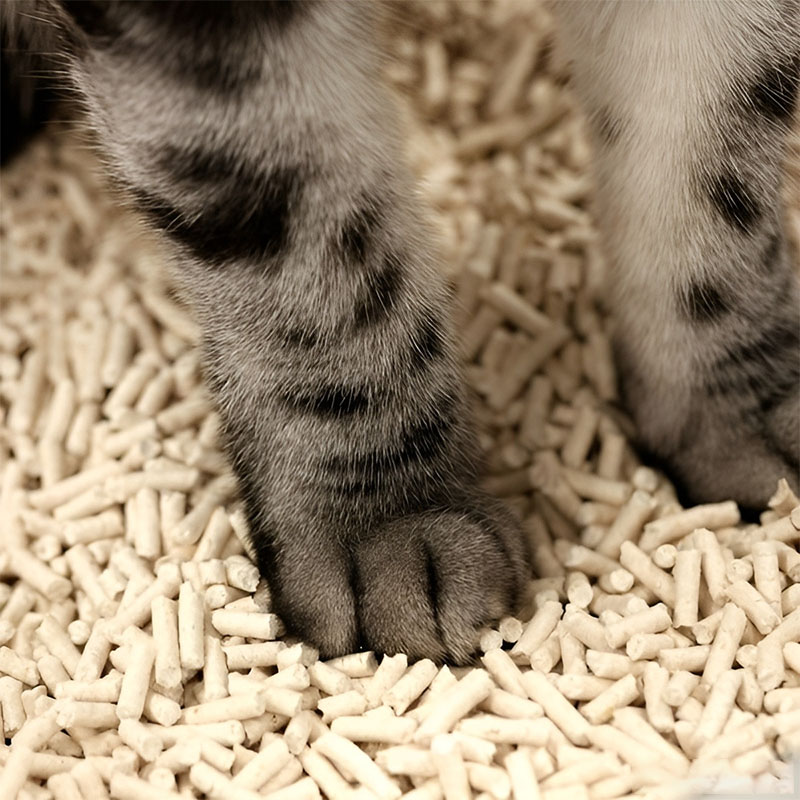
The word gets used loosely. In practice the cat litter pellet aisle splits three ways: wood pellets pressed from sawdust, paper pellets pressed from recycled cellulose, and starch-based pellets pressed from plant flour. All three behave differently from the granulated products most importers move in volume, because bentonite and tofu litter are formed by rounding or extrusion and are sold as granules rather than pellets. That distinction decides the handling rules before you write a spec sheet: sifting trays instead of scoops, different dust behaviour, and end-of-life claims that vary by material. It also shapes which cat litter industry trends a given format is riding.
Pine and wood cat litter pellets
Pine and wood pellets are the best-known family. The pellet holds its shape when dry and splits back into loose sawdust when wet, which is why this family pairs with a double-layer or sifting tray rather than a standard scoop. It is bought for low dust and straightforward cleanup, and because the raw material is a wood by-product the sourcing story starts with where the sawdust comes from. AiSha’s wood grades sit under its pine cat litter pellets range, next to its granule SKUs.
Paper and starch-based cat litter pellets
Paper pellets are pressed from recycled cellulose and are chosen where dust really cannot be tolerated; they absorb by swelling rather than splitting. Starch-based pellets are pressed from corn, cassava or pea starch and sit closer to clumping behaviour, but the formula decides whether they clump, disperse, or simply soften, so ask which one you are buying. Flushability is never implied: it applies only where the label and the local plumbing rules both allow it. Both families are the natural starting point for the biodegradable work below, because the base material already comes from plants.
The table compares families, not a single SKU. Dust rate, moisture and particle size still have to be confirmed against the specification for the product actually being bought.
| Cat litter pellet type | Made from | Behaviour when wet | End of life | Typical fit |
| Pine pellet | Compressed pine sawdust | Splits into loose sawdust; needs a sifting tray | Compostable where the label states it | Wood-based, low-dust SKUs |
| Wood pellet | Mixed softwood / hardwood sawdust | Same split behaviour, coarser residue | Compostable / biodegradable as labelled | Price-sensitive wood lines |
| Paper pellet | Recycled cellulose | Absorbs and swells; very low tracking | Recyclable where facilities accept it | Dust-sensitive indoor ranges |
| Starch-based pellet | Corn, cassava or pea starch | Clumps or disperses depending on formula | Plant-based; flushable only if labelled | Buyers wanting a plant clumping SKU |
| Bio-polymer blend (PLA/PBAT/PHA) | Fermented or synthesised bio-polymers | Under evaluation for strength vs. degradation | Target: verified full biodegradation | Roadmap stage, not commercial yet |
Why Green Matters beyond the Cat Litter Pellet
Plastic is the unavoidable topic in pet products. A discarded plastic toy can take centuries to break apart, and along the way it sheds microplastics that move into soil, water and eventually the food chain; the U.S. EPA plastics programme documents plastic waste as widespread in both natural and built environments. For a factory this is a design question before it is a marketing one, because a bag of litter is used, bagged and thrown away every week of the year. For buyers the same shift has become a line item: European retailers increasingly ask what the product is made of and how it is disposed of, and the answer has to survive the follow-up question.
The Four R&D Steps behind Green Cat Litter Pellets
Fully biodegradable materials are the headline of the green roadmap, and the development path behind that headline runs in four steps. Each step filters out suppliers who are talking and leaves the ones who are building.
Step 1: material selection
The bio-based family is assessed on three axes at once: mechanical performance, processing window, and degradation behaviour. PLA is strong but brittle; PBAT is flexible but limited on heat; starch and modified cellulose bring cost and availability but lose strength in humid conditions. There is no perfect material, only a formulation that fits the product it has to become.
Step 2: formulation and modification
Blending, toughening and nucleation modification reconcile two demands that pull in opposite directions: strong enough to survive a pallet, a container and a cat, and weak enough to break down properly once it is discarded. This is the core tension of the category and the place where most timelines quietly slip.
Step 3: degradation verification
Degradation rate, cycle time and product safety are tested under simulated industrial composting, home composting, soil and freshwater conditions. Real biodegradation means conversion into carbon dioxide, water and biomass rather than fragmentation into smaller plastic, and the verification standard is stricter than the material claim itself. The reference usually cited for compostable plastics is the ASTM D6400 compostability specification, which sets out what must be proven before a product carries the claim in industrial facilities. Independent bodies such as SGS are the normal route to a third-party report.
Step 4: scale-up to mass production
A laboratory formulation is not a product. It has to pass through pilot runs and process alignment before it can run on PLC-automated lines at a cost the market will accept (company-cited roadmap). The plan also links with universities and research institutes to build a shared degradation-materials laboratory, advancing category by category rather than switching everything at once, with the systematic switch of main product lines targeted before 2030 (company-cited).
The Low-Carbon Factory Making Cat Litter Pellets
If biodegradable materials answer the green question on the product side, the low-carbon factory answers it on the production side. The plant is already automated and digitalised: PLC-controlled lines keep 300,000 tonnes of annual capacity stable (company-cited). The low-carbon layer is an energy and carbon management system built on top of that base.
Energy management on existing lines
The described roadmap includes rooftop solar turning coastal sunshine into plant power, and waste-heat recovery from injection machines feeding workshop heating and process preheating (planned, company-cited). The instrument that makes either measure useful is visibility: a full-chain carbon accounting system covering raw-material purchase, production and logistics, so each tonne carries a quantifiable carbon bill. Targets come after the bill — phased decarbonisation, a carbon-neutrality timetable, and green-supply-chain entry standards reviewed year by year against actual data.
Water reuse and packaging reduction
A water-treatment loop for reuse and lighter packaging moving away from single-use plastic are the two items that touch the buyer most directly, because both show up in the physical shipment rather than in a report. Packaging is also the claim most often overstated: a recyclable film is only recyclable where the infrastructure exists, so the wording on the bag has to match what the buyer’s market can process. The stated ambition is a benchmark zero-carbon factory for the pet-products industry (company-cited).
The Smart Ecosystem around Cat Litter Pellets
Pets cannot talk, but their bodies produce data. In AiSha’s smart-ecosystem concept (company-cited), the product relationship continues after the sale: smart feeders portion daily food by weight, age and activity, while sensor-equipped litter boxes record bathroom frequency and waste condition.
Health signals from the litter box
The useful part is pattern rather than measurement. A cat drinking less for three days, or a dog becoming restless at night, reads as noise to an owner and as a signal to a model. The vision positions AI as a family vet assistant: it does not replace the veterinarian, it helps the owner book the appointment before a problem becomes serious. That framing matters legally as much as commercially, since a health-adjacent product has to be honest about what it can and cannot do.
Usage data feeding back into production
The data also flows backwards into product development: usage patterns across large numbers of pets tell the team which granule size clumps fastest, which tray geometry suits senior animals, and which material survives chewing, so development moves from guessing to calculating. Inside the factory, digital twins simulate whole production lines, AI visual inspection checks outgoing product at millimetre scale, and full-chain traceability ties every bag to a day, a line and a raw-material batch (company-cited).
Three Phases in the Cat Litter Pellet Roadmap
| Phase | Years | Market | R&D / factory / smart |
| Foundation | 2026–2028 | Deepen the existing 86 countries; regional R&D and service centres in Europe and North America | Biodegradable pilot line; low-carbon factory phase one |
| Acceleration | 2029–2032 | Expand beyond 100 countries and regions | Biodegradable range fully launched; zero-carbon factory operating; smart ecosystem at scale; AI health services covering millions of pet households |
| Leadership | 2033–2035 | Standards export — participation in international pet-product standards | Chinese materials, safety and environmental experience written into global industry language |
These phases are a roadmap rather than a delivery schedule. Every milestone — capacity, country count, factory status — has to be confirmed with the supplier and verified in writing at the time of purchase. The plan extends a path already travelled, moving from 250,000 to 300,000 tonnes of annual capacity and from 76 to 86 countries (company-cited).
Three Pitfalls in Reading a Cat Litter Pellet Manufacturer Roadmap
Pitfall 1: treating a roadmap as today’s fact
A biodegradation switch before 2030 and a zero-carbon factory in 2035 are commitments, not current states. Ask which milestones have already been reached, what the test reports say, and what is still at the design stage — then write the answers into the contract rather than the brochure.
Pitfall 2: reading green claims without evidence
Biodegradable, compostable and carbon-neutral all carry legal weight in environmental marketing. The FTC Green Guides require such claims to be truthful and substantiated, and using a third-party certification does not remove that obligation. Hold every claim to its test report and to the exact wording that ends up on the bag.
Pitfall 3: judging the plan without the factory
A roadmap reads well on a slide. Check it on the ground: lines running, batch data available, samples testable, and current status documented before comparing plans across suppliers. Start with what the cat litter pellet manufacturer can show today, then weigh the promises against it. The factory visit stays the strongest evidence for any supplier story.
Incoming Checks for Cat Litter Pellet Shipments
For pellet shipments moving today, three checks catch nearly every problem before it becomes a customer complaint. Each takes minutes at the warehouse door.
Granule integrity. Crushed pellets turn into dust, and dust is product already paid for that cannot be sold. Weigh the fines in a sample rather than trusting how the pallet looks.
Moisture and odour on arrival. Pellet lines pick up water. Confirm moisture against the agreed specification on arrival and check that the material is odour-neutral: a sweet or musty smell usually points to moisture absorbed in transit.
Retained samples. Keep per-batch samples and match them against the Certificate of Analysis. The equivalent habit for roadmap claims is keeping correspondence, because written confirmation of milestones is the buyer’s audit trail when a launch date slips.
Conclusion: The Roadmap as a Promise
In AiSha’s framing, the future is a responsibility rather than a date: green materials so the product can go back to nature, a low-carbon plant so production is gentler on the environment, and a smart ecosystem so owners and animals understand each other better. The strongest promise is the one being built step by step, which is exactly why buyers should treat the roadmap as a promise to verify and the current catalogue as the evidence to check. Ask for today’s product data, samples and written milestone confirmation through the お問い合わせページ. Every current figure here is company-cited, and every forward statement is a roadmap commitment that must be confirmed in writing.
Frequently Asked Questions About Cat Litter Pellets
What is a cat litter pellet?
A cat litter pellet is a granule pressed from plant material rather than a mined mineral. The common families are pine and wood pellets made from compressed sawdust, paper pellets made from recycled cellulose, and starch-based pellets pressed from corn, cassava or pea starch. They are bought for low dust and simple cleanup, and they behave differently from granulated bentonite or tofu litter, which are formed rather than pressed.
What are cat litter pellets made of?
Wood-based pellets start as kiln-dried sawdust pressed under pressure, usually with no binder added. Paper pellets use recycled cellulose. Starch-based pellets use plant flour, sometimes with a small binder for clump strength. The next generation under development uses bio-polymers — PLA, PBAT and PHA — blended and modified for strength.
When will biodegradable cat litter pellets actually ship?
Per the company roadmap, the systematic switch of main product lines to fully biodegradable materials is targeted before 2030, after pilot lines and trial runs (company-cited). That is a target rather than a shipping date. Confirm current shipment status and request written milestones before building a launch calendar around it.
Does fully biodegradable mean home-compostable?
Not automatically. Degradation is verified under defined conditions — industrial composting, home composting, soil or freshwater — and results differ by environment. A pellet that passes an industrial composting test can still sit for months in a home heap. Ask which conditions were tested and read the report rather than the badge.
How do I check a cat litter pellet manufacturer’s green claims?
Ask for three things and confirm they agree: the claim you intend to print on the bag, the test report behind it, and the standard it was tested against. Check the issuing lab and the date, then look at whether the claim is qualified, because unqualified terms such as eco-friendly are the ones regulators challenge first.
Is the low-carbon factory already operating?
The PLC-automated base exists today. The energy and carbon layer — rooftop solar, waste-heat recovery, water reuse, full-chain carbon accounting — is described as partly in progress (company-cited). Verify current status before repeating it to your own customers, since this is the section most likely to move between visits.
Are the smart litter-box products on sale today?
The smart ecosystem is a company vision: smart feeders, sensor-equipped litter boxes, a pet health-file app and AI assistance are described as concepts and next-phase products rather than catalogue items (company-cited). Treat them as direction of travel, and source from the current range for anything shipping this season.
 Japanese
  English
  Spanish
  Russian
  Arabic