Основные выводы
- Capacity is a delivery promise, not a brochure number: ask for monthly throughput per line, not only the 300,000-ton annual output a factory will quote.
- Raw material silos and a climate-controlled finished goods warehouse are what let a supplier absorb a seasonal spike without moving your date.
- Multi-category lines for tofu, bentonite, mineral and pine let one container carry several SKUs and cut port waiting time.
- Batch consistency is provable: moisture, clumping strength, dust percentage and absorbency results, plus a certificate of analysis with every batch.
- First OEM orders (about 20-25 days after artwork approval) and repeat orders (10-14 days) carry different lead times; build your reorder point around the repeat figure.
- Peak-season allocation should be agreed in writing before the season starts, not negotiated while it is already running.
- A sample proves one batch; a three-level inspection record and a batch traceability file prove a system.
Для кого предназначено данное руководство: For importers, distributors, wholesale buyers, chain purchasers and private-label brand owners comparing suppliers before committing a container programme, who need to judge stable supply rather than one good sample. Not for retail-bag buyers.
Bentonite Litter Factory Checklist: What B2B Buyers Should Verify
| Что необходимо проверить | Question to ask | Why it decides supply |
| Line capacity | How many lines run bentonite, and what is the monthly throughput? | Tells you whether a spike can be absorbed without queueing behind other categories |
| Utilisation and allocation | Who gets priority when the lines fill up? | Export-first allocation protects your delivery date in peak season |
| Raw material storage | Do you hold silos of natural sodium bentonite on site? | Buffers against seasonal raw material shortages and price swings |
| Finished goods storage | Is the finished goods warehouse climate-controlled? | Protects moisture level and clumping behaviour through transit and storage |
| Category range | Can you run tofu, mineral and pine on the same site? | Enables mixed containers and one shared quality system |
| Quality evidence | Do you provide per-batch lab data and a certificate of analysis? | Makes consistency contractible instead of a matter of opinion |
| Срок выполнения заказа | What is the lead time for a first OEM order versus a repeat? | Sets your reorder point and the safety stock you hold at destination |
Bentonite Litter Factory Capacity: How Automation Decides Your Delivery Date
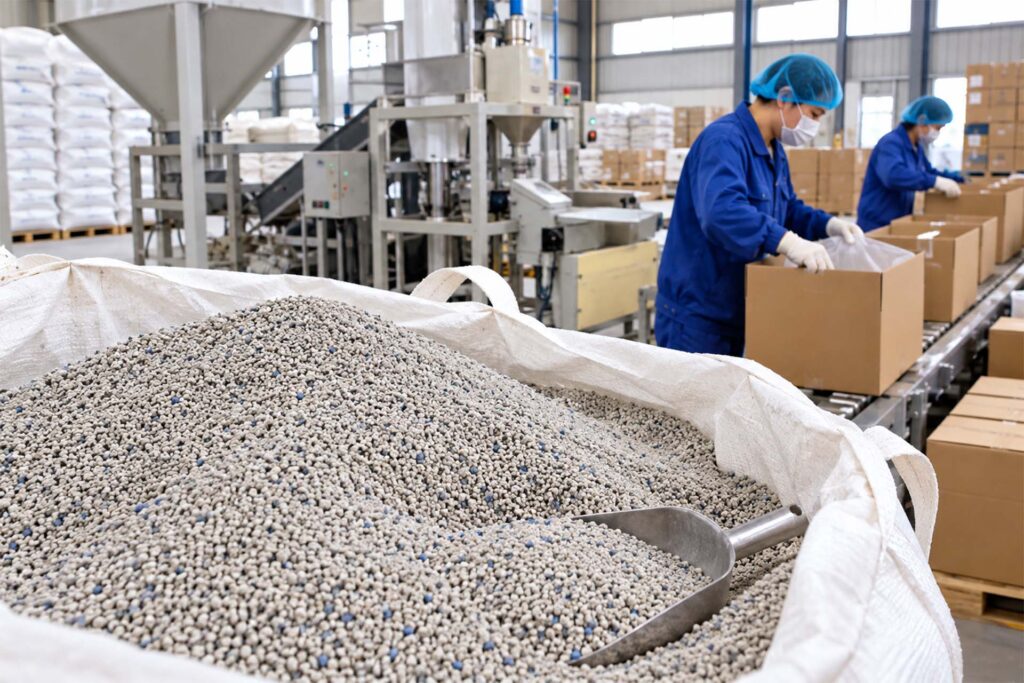
An annual output figure of 300,000 tons across multiple automated production lines (company-cited) is a headline, not a schedule. It does not tell you who gets served when demand bunches into the same eight weeks. What matters is monthly throughput per line, the utilisation rate behind it, and how lines are allocated.
Monthly throughput per line, not the annual headline
The annual number averages out the months when the plant runs flat out and the months when it does not. A buyer screening a bentonite cat litter manufacturer needs the per-line monthly figure, because that is the number your order competes against during the spike.
Automation that turns a promise into a plan
Automation is what turns a promise into a plan. Dosing equipment, not operators’ eyes, controls mixing, drying, coating and bagging, which removes the variance that shows up as inconsistent grain size or clumping speed three months into a contract. Where multi-stage airflow dedusting runs through crushing, drying and screening, fine powder is pulled out before the product reaches the bag, so low-dust performance becomes a measured output rather than a slogan. Ask how many lines serve your category, and how much capacity is already committed.
Silos and Climate-Controlled Warehousing: The Buffering Inside a Bentonite Litter Factory
Two storage assets quietly decide whether a supplier can hold a date: raw material silos and a climate-controlled finished goods warehouse.
Silos of natural sodium bentonite let a plant keep producing when incoming supply tightens, exactly when competitors start quoting longer lead times. A warehouse with controlled temperature and humidity protects the product after it is made: once a bag absorbs damp air in a humid port or a poorly ventilated destination warehouse, the clump strength the customer paid for is gone before the box is opened. Ask for racking, ventilation and stock rotation records.
Full-Category Supply: Why a Bentonite Litter Factory Should Run Four Lines
Bentonite is the volume mainstay of this category, but a buyer who looks only at bentonite leaves freight money on the table. A site that also runs tofu, mineral and pine lines can consolidate several SKUs into one container, cutting freight cost per unit and the time your goods wait at the port.
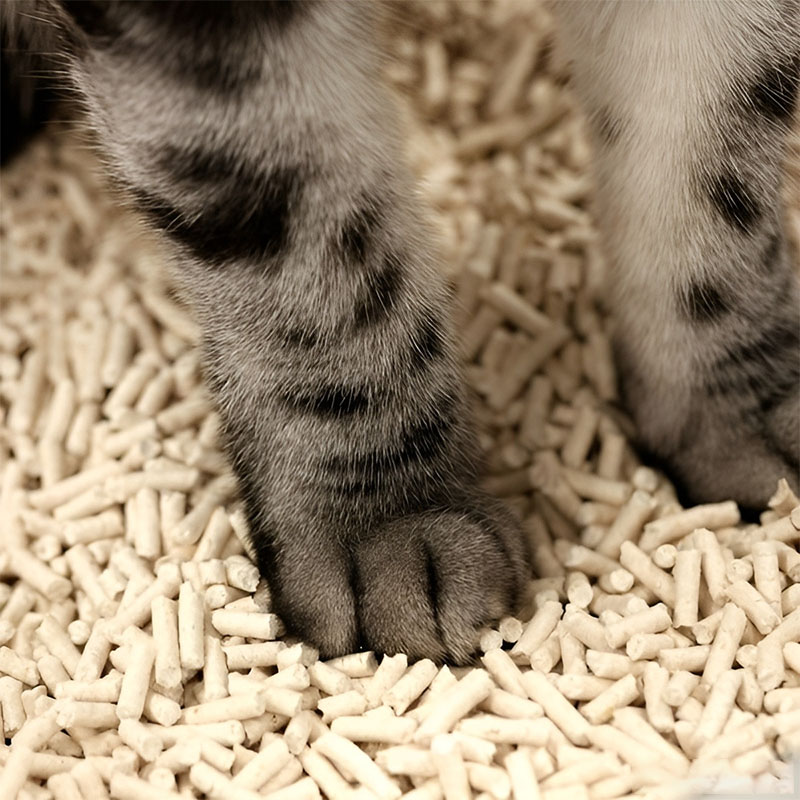
The range matters for shelf logic too: a tofu line producing uniform granules between 1.5 mm and 3.0 mm serves shoppers who want a plant-based option, a mineral line serves the dust-sensitive end, and a pine line serves wood-bedding buyers. Confirm how brand ownership is handled: a mature manufacturer runs an own brand portfolio alongside OEM private-label production, and offers both stock packaging or generic packaging for a fast market test and printed packaging once volume justifies the tooling.
Batch Consistency: What a Bentonite Litter Factory Must Prove Every Load
Consistency is the whole product in this category. Buyers rarely lose money on a bad sample; they lose it on the fourteenth batch that quietly drifted while everyone was watching the first one.
Four measured values beat a claim
A serious factory shows four measured values rather than a claim: moisture, clumping strength, dust percentage and absorbency, tested in-house on every batch before it is cleared for loading. Ask for a certificate of analysis with each shipment, and write the acceptable test range into your specification so a drift becomes a claim rather than an argument.
Batch traceability and three-level inspection
Batch traceability is the other half: every batch should link to a file recording the raw material batch, line, shift, production time and test data, so a complaint six months after arrival can be traced to a stage. That structure comes from three-level inspection covering incoming material, in-process line control and finished goods; a профессиональный производитель наполнителей для кошачьих туалетов в Китае documents this line by line.
Peak-Season Stocking and the Delivery Rhythm of a Bentonite Litter Factory
Delivery reliability is engineered before the order arrives. Pin down the lead-time split first: a first OEM order that needs new packaging plate manufacturing typically runs about 20-25 days after artwork approval, while repeat continuous orders are usually processed and loaded within 10-14 days (company-cited). Confusing the two is how buyers end up short in month four.
Lead-time split between first OEM and repeat orders
Treat the two lead times as different products. The first order carries tooling and approval risk; the repeat order is what your reorder point must be built around, because that is the cadence your retail customers will feel.
Stocking policy and port discipline
Stocking policy is the second variable. A supplier who reserves line capacity for peak-season orders in advance, and lets annual-contract buyers lock monthly volume and price terms, is selling stability rather than a spot quote. The third is port discipline: goods that clear the factory but sit waiting for a booking do not arrive any faster. See the Руководство по оптовым поставкам кошачьего наполнителя на условиях OEM for how global buyers structure this with their suppliers.
Hygiene, Dust, Handling and Storage: What a Bentonite Litter Factory Should Document
Handling and hygiene guidance for downstream resellers
Bulk supply is also a documentation question. Buyers reselling into multi-cat households, shelters and catteries are asked for handling guidance, and the litter-box management guidance published by the ASPCA is a sensible baseline. Hygiene matters too: because cat faeces can carry a parasite, the cleanliness practices summarised by the US Centers for Disease Control and Prevention – glove use, hand washing, daily box changes – are worth passing to downstream handlers. Because fine particulate matter is a recognised indoor air-quality concern, the source-control guidance from the US EPA indoor air quality programme belongs in the same note.
Storage and incoming checks at destination
Store finished goods off the floor on pallets in a dry, ventilated warehouse, and keep humidity steady; moisture invites clumping and mould, and no factory can compensate for a damp destination warehouse. Rotate stock so older batches ship first. At receiving, check bag condition, net weight and production dates against the packing list, spot-check dust and granule size against your agreed range, and retain one sealed sample per batch – the cheapest insurance in the chain, because it settles a performance question in minutes. Goods ship from Dalian port, so confirm the current lead time, order terms and destination requirements in writing before the first order.
Choosing the Right Bentonite Litter Factory for Your Channel
Importers and distributors:
- Importers and distributors: weight the evaluation towards monthly throughput, utilisation, allocation and the repeat-order lead time.
- Chain and wholesale buyers: batch consistency matters most, because one bad pallet across thirty stores is a problem in thirty locations.
- Private-label brands: confirm particle size and shape options, fragrance and active-ingredient additions, and packaging design capability with an OEM/ODM cat litter factory.
- Test-market entries: start with stock packaging or generic packaging on a mixed container and keep printed tooling for the second order.
Three Mistakes Buyers Make When Screening a Bentonite Litter Factory
Mistake 1: Judging on samples alone
A well-run sample programme proves the factory can make one good batch under supervision; it says nothing about a Tuesday night shift in week twelve. Ask for the three-level inspection records, the batch traceability file and the outgoing quality documents behind that sample, then compare them against the specification you intend to write.
Mistake 2: Letting a quote stand in for a supply plan
A price per container is not a supply plan. A quote tells you what one shipment costs; a supply plan tells you what happens in a peak month, who has priority when lines fill, and how volume and price behave across a year. Convert the quote into a twelve-month schedule with volumes, delivery windows and a named allocation, then ask whether the factory will sign it.
Mistake 3: Skipping peak-season allocation
Most supply failures in this category are not caused by a factory that cannot produce; they are caused by a buyer who never asked who had priority when everyone needed the same eight weeks. Agree peak-season allocation in writing before the season begins, including monthly volumes, a notification window if volumes change, and the lead time for the extra load.
Conclusion: Turning a Bentonite Litter Factory Into a Supply Partner
Stable supply is a system, not a promise. Buyers who avoid empty shelves check monthly throughput per line, confirm silo and warehouse buffering, insist on per-batch lab data and a certificate of analysis, and agree peak-season allocation in writing before the season begins. Do those four things and whether a supplier can hold your programme for a year stops being a matter of trust and becomes a matter of record.
If you are screening a cat bentonite litter supplier for a container programme, the next step is a specification conversation: fit, dust, clumping behaviour and packaging, matched to your market and volume. Review the Страница продукта «Бентонитовый наполнитель для кошачьего туалета» for specifications and packaging options, then send your target SKUs, volumes and destination so the team can quote a schedule rather than a price.
Часто задаваемые вопросы
Practical questions B2B buyers ask when screening a bentonite litter factory before committing a container programme.
How do I judge whether a supplier can supply steadily?
Ask for monthly throughput per line, the allocation logic, per-batch lab data, and the lead-time split between first OEM and repeat orders, then confirm it all in writing.
What is the lead time for a first OEM order?
With new packaging plate manufacturing, about 20-25 days after artwork approval; repeat continuous orders are typically processed and loaded within 10-14 days (company-cited).
How is quality kept consistent across batches?
Automated dosing holds grain size, moisture and clumping speed steady, and in-house testing of moisture, clumping strength, dust percentage and absorbency clears each batch, with a certificate of analysis per batch (company-cited).
Can one container mix several litter types?
Yes. A site running tofu, bentonite, mineral and pine lines can consolidate SKUs into one container, provided the mix is agreed before production starts.
How should I think about dust and odour performance?
Dust is a particulate matter question and odour an absorbency and clumping question; multi-stage airflow dedusting and controlled moisture are the two levers that affect both.
Do eco or biodegradable claims matter for a B2B buyer?
Yes, where your retail customers ask, but any claim must be substantiated, and the US FTC Green Guides set the standard that environmental claims must meet.
Do I need to visit the factory before ordering?
Not always. A live video walkthrough that opens inspection records, plus a third-party inspection or an SGS test report, can complete a paper audit, and social compliance can be reviewed through schemes such as amfori BSCI.
 Russian
  English
  Spanish
  Japanese
  Arabic