In the modern pet – keeping system, cat litter is a high – frequency consumable pet product. It has a wide range of use and a high replacement frequency. Since it is in long – term close contact with cats, its quality is directly related to the cats’ health. As the pet consumer market continues to expand, the importance of cat litter manufacturing standards has become increasingly prominent.
There is a wide variety of cat litter on the market with a large price range, from affordable bulk products to refined customized ones, and the quality gap is significant. Many cat owners rely only on their sense of smell, visual perception, and word – of – mouth recommendations when purchasing, lacking the professional ability to distinguish product quality. As a result, they are likely to buy inferior products.
To select safe, durable, and suitable cat litter from the wide range of products, the most reliable way is to trace back to the production end and understand the production logic, raw material control, processing technology, and quality inspection system established under professional cat litter manufacturing standards. Whether it’s for ordinary household cat – keeping or large – scale cat – gathering places, knowing the production standards of high – quality cat litter companies can effectively avoid the hidden risks caused by inferior products and ensure a clean and safe living environment for cats from the source.
Raw Material Screening Under Cat Litter Manufacturing Standards
Raw material screening is the first step in the production process of a cat litter company and is crucial for determining the basic quality of cat litter. Strict cat litter manufacturing standards require regular production enterprises to establish rigorous raw material access thresholds, rejecting industrial waste and inferior materials. They select pure – natural, low – irritation, and residue – free raw materials according to different types of cat litter.
Plant – Based Cat Litter Raw Materials
When producing plant – based cat litter, compliant companies usually use food – grade corn starch, natural tapioca fiber, and natural straw materials. The raw materials are free of mold and impurities and do not require industrial bleaching. Even if a cat accidentally eats a small amount of this cat litter, it won’t cause a burden on its stomach. Such material selection processes are an important part of advanced cat litter manufacturing standards.
Mineral – Based Cat Litter Purification
Mineral – based cat litter is made from deep – layer bentonite. Through multiple water – washing and purification processes, heavy metals, sulfides, and hard impurities in the ore are removed, reducing dust and harmful residue. These purification procedures directly reflect the professionalism of modern cat litter manufacturing standards.
Risks of Inferior Raw Materials
In contrast, small processing workshops with incomplete qualifications use industrial scraps and recycled waste to make cat litter to cut costs. The raw materials are mixed with dust, insect eggs, and chemical residues. Long – term use of such cat litter can continuously irritate the cat’s nose, paw pads, and skin, leading to chronic inflammation. For large – scale cat – gathering places, the transparent raw material lists required by strict cat litter manufacturing standards can maximize the health of the cat group and reduce the occurrence of group skin diseases and respiratory problems.
Deep – Processing Technology and Cat Litter Manufacturing Standards
Deep – processing technology determines the feel, dust level, and durability of cat litter, and it is also the key factor that differentiates high – quality cat litter companies from ordinary processing factories. Professional enterprises follow refined cat litter manufacturing standards and use multi – step physical processing techniques instead of rough high – temperature incineration and chemical mixing.
Low – Temperature Drying and High – Pressure Molding
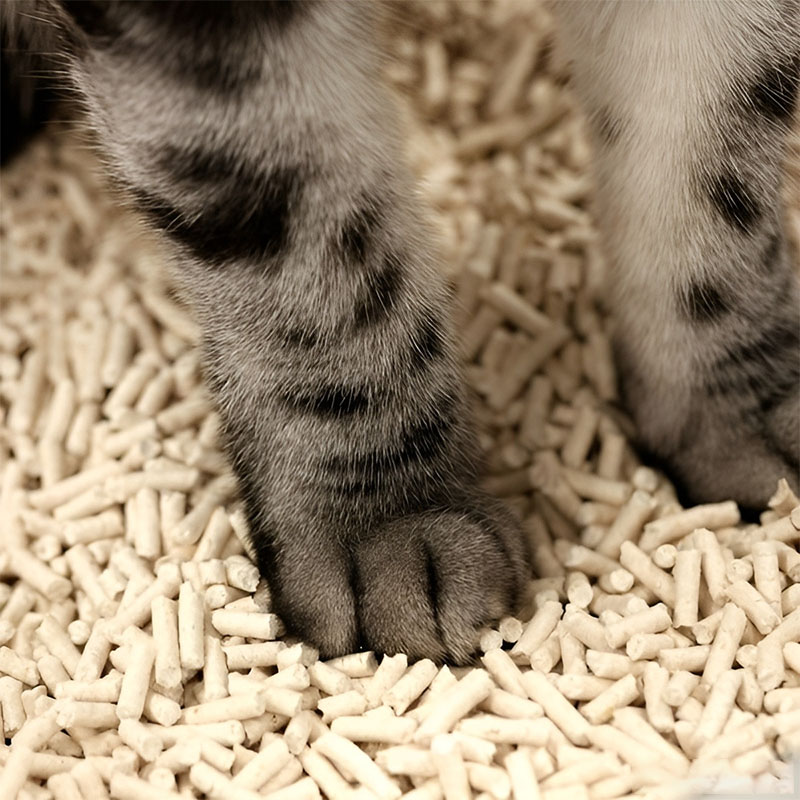
Plant – based cat litter goes through three processes: low – temperature drying, high – pressure molding, and secondary dust removal. This strengthens the particle structure and reduces the generation of debris during transportation and use.
Water – Grinding and Particle Grading
Mineral – based cat litter is polished by water – grinding and graded by particle size, making the sand grains round and uniform and preventing sharp edges from scratching the cats’ paw pads. Such precision processing technologies are widely recognized in advanced cat litter manufacturing standards.
Dust – Free Production Workshops
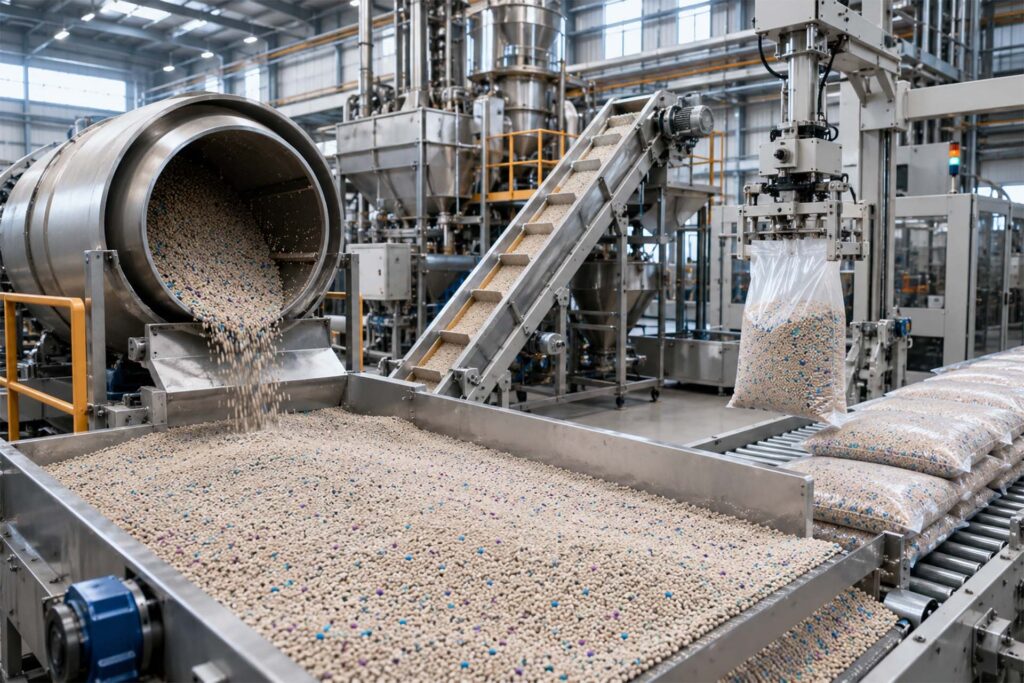
Most mature cat litter companies are equipped with closed, dust – free production workshops and use fully mechanized processing to reduce human – induced pollution. They also use negative – pressure dust – removal equipment to remove floating dust from the raw materials, keeping the dust content at a very low level according to modern cat litter manufacturing standards.
Problems Caused by Inferior Processing
Inferior cat litter that has not been finely processed has irregular particle sizes and uneven hardness. It is prone to breakage and dust generation during use, which not only pollutes the indoor air but also attaches to the cats’ fur and between their toes. If ingested by the cats over a long period, it can easily cause intestinal blockage. A delicate and complete processing technology can optimize the feel and usage experience of cat litter, making it suitable for cats of different ages and constitutions.
Quality Inspection Systems in Cat Litter Manufacturing Standards
The quality inspection system is an important guarantee for cat litter companies to control product qualification rates and stabilize product quality. Strict cat litter manufacturing standards require regular enterprises to establish independent quality inspection laboratories equipped with professional testing equipment.
Multi – Dimensional Product Testing
They conduct sampling tests on each batch of cat litter produced, including multiple indicators such as dust content, clumping speed, water – absorption rate, odor – adsorption ability, bacterial colony count, and harmful chemical residue. Only products that pass the inspection can be packaged and shipped. Unqualified batches are discarded to prevent them from entering the consumer market.
Animal Adaptability Testing
Some high – standard cat litter companies also conduct additional animal adaptability tests. They observe the feedback from cats of different breeds and ages to optimize the hardness and odor concentration of the cat litter, reducing the probability of cats rejecting it.
Special Standards for Multi – Cat Environments
For the special – purpose cat litter customized for cat – gathering places, the quality inspection standards are further upgraded, focusing on antibacterial and anti – mildew capabilities to ensure that the cat litter is not easily spoiled and does not easily breed mites and bacteria in a high – density breeding environment.
How Consumers Can Verify Quality
Ordinary cat owners can check the test reports and quality inspection standards marked on the product packaging when purchasing to judge the professionalism of the cat litter company and confirm whether the product complies with recognized cat litter manufacturing standards, avoiding products without testing, qualifications, or standards.
Formula R & D and Product Segmentation Based on Cat Litter Manufacturing Standards
Formula R & D and product segmentation are the core development directions for modern cat litter companies to meet market demand and improve their product matrix. As cat owners become more conscious of refined pet – keeping, general – purpose cat litter can no longer meet diverse needs. Professional enterprises continuously upgrade their cat litter manufacturing standards and develop segmented products according to cats’ physiological characteristics.
Cat Litter for Kittens
For kittens with weak stomachs and strong curiosity, cat litter companies optimize the raw material ratio, reduce the bonding strength, and produce fine – grained, digestible, and low – irritation cat litter.
Nursing – Type Cat Litter for Elderly Cats
For elderly cats with weak immune systems, natural antibacterial ingredients are added to create nursing – type cat litter that is safer and gentler.
Heavy – Duty Cat Litter for Multi – Cat Environments
For cat – gathering places with multiple cats and strong odors, heavy – duty mixed cat litter with high adsorption and strong odor – locking capabilities is developed to meet high – intensity usage requirements under strict cat litter manufacturing standards.
Scientific Odor Control Technology
In terms of odor adjustment, high – quality cat litter companies abandon cheap industrial fragrances and use plant – extracted light scents or fragrance – free formulas. They rely on activated carbon and zeolite to physically adsorb odors, which won’t burden the cats’ sense of smell.
Inferior manufacturers add strong chemical fragrances to cover up the odor of raw materials. Although it can temporarily mask bad smells, long – term inhalation can cause the cats’ sense of smell to deteriorate and damage their respiratory tracts. Scientific and gentle formula design developed under professional cat litter manufacturing standards makes cat litter suitable for different breeding scenarios while balancing practicality and safety.
Packaging, Warehousing, and Transportation Specifications
Packaging, warehousing, and transportation specifications also reflect the comprehensive production strength of a cat litter company. Qualified cat litter products manufactured according to reliable cat litter manufacturing standards are packaged in thick, moisture – proof sealed bags with anti – leakage inner membranes to isolate air and moisture, preventing the cat litter from getting damp, clumping, or moldy during storage.
Transparent Product Labeling
The outer packaging is clearly printed, indicating the raw material composition, production batch, implementation standards, and production address, making the information transparent and traceable.
Bulk Storage Solutions for Large – Scale Supply
In large – scale supply channels, cat litter companies provide large – capacity, moisture – proof storage packaging for cat – gathering places, facilitating bulk storage and long – term stockpiling.
Transportation Standards and Product Protection
Closed freight carriages are used for transportation to avoid exposure to sunlight and rain, ensuring that the cat litter arrives dry and intact. Inferior products, however, often have thin packaging with loose seals. They are prone to getting damp and breaking during transportation, generating large amounts of dust when opened and severely affecting the user experience.
A complete warehousing and transportation system designed under strict cat litter manufacturing standards can preserve product quality, reduce transportation losses, and better protect consumers’ rights and interests.
Rational Selection of Cat Litter Based on Manufacturing Standards
For all types of cat owners, identifying the comprehensive strength of cat litter companies and understanding professional cat litter manufacturing standards are the prerequisites for rationally purchasing cat litter.
Focus on Production Quality Instead of Marketing
When choosing cat litter, consumers should not be misled by fancy packaging or exaggerated marketing. Instead, they should focus on the raw material source, processing technology, quality inspection qualifications, and formula logic.
Recommendations for Household Cat Owners
For household cat – keeping, it is important to avoid inferior cat litter with strong fragrance, high dust, and many impurities to protect cats’ respiratory tracts and stomachs.
Recommendations for Cat – Gathering Places
Cat – gathering places should rely on reliable suppliers to customize highly suitable and durable special – purpose cat litter to maintain the hygiene of the group – living environment.
Only by emphasizing product quality at the source and selecting products that comply with advanced cat litter manufacturing standards can cat litter truly fulfill the functions of cleaning, antibacterial protection, and health support.
Additional Considerations in Cat Litter Manufacturing Standards
In the actual purchasing process, consumers can initially judge the professionalism and reliability of a cat litter company by checking whether it has relevant production qualifications, whether it discloses raw material traceability information, and whether it provides third – party test reports.
Importance of Product Standards and Certifications
Consumers should also pay attention to whether the product clearly marks implementation standards such as group standards, enterprise standards, or industry – recommended standards. These details help distinguish compliant products from counterfeit or low – quality ones and are important indicators of professional cat litter manufacturing standards.
After – Sales Service and Consumer Support
Regular cat litter companies usually provide a complete after – sales service system, offering professional answers to product – use questions and return and exchange guarantees, further demonstrating their commitment to product quality and consumer responsibility.
Digital Production and Traceability Systems
Consumers can also understand the company’s production environment and process through on – site inspections or online channels and observe whether it has standardized workshops, closed production lines, and a complete quality traceability system.
Some leading companies have achieved full – process digital management, with data records from raw material warehousing to finished product delivery, ensuring that every batch of products is traceable and controllable. This transparent production model improves product consistency and strengthens compliance with modern cat litter manufacturing standards.
Environmental – Friendly Production and Sustainable Cat Litter Manufacturing Standards
Cat litter companies with systematic production standards usually integrate environmental protection concepts into the entire production chain. Modern cat litter manufacturing standards increasingly emphasize sustainability and ecological responsibility.
Biodegradable Plant – Based Cat Litter
Plant – based cat litter gives priority to substrates with high biodegradability and compostability during the formulation stage to reduce the long – term environmental burden.
Optimized Mineral – Based Products
Mineral – based products extend their service life by optimizing the particle structure, reducing replacement frequency and indirectly reducing resource consumption.
Green Manufacturing and Waste Recycling
Some companies have introduced green – energy – driven production lines to reduce carbon emissions and have classified, recycled, and reused processing waste to form a closed – loop production model. This production logic combining pet health and ecological sustainability reflects the evolution of modern cat litter manufacturing standards.
Sustainable Packaging Solutions
Packaging materials are gradually transitioning to recyclable and degradable options, such as kraft – paper composite films and water – soluble liners, reducing secondary pollution and supporting environmentally friendly consumption trends.
Certification and Social Responsibility in Cat Litter Manufacturing Standards
This dual commitment to environmental protection and quality is also reflected in the company’s certification system and social responsibility practices.
Environmental Certifications and Third – Party Verification
Forward – looking cat litter companies usually actively apply for international or domestic authoritative environmental certifications, such as FSC forest certification, compostability certification, or carbon – footprint verification, to enhance product credibility through third – party endorsement.
ESG Reporting and Corporate Transparency
Some companies also regularly publish environmental, social, and governance (ESG) reports, publicly disclosing resource – use efficiency, waste – treatment effectiveness, and animal – welfare – related measures for public supervision.
The Future of Cat Litter Manufacturing Standards
This transparent operation not only enhances brand credibility but also provides consumers with more valuable decision – making references. In today’s pet economy, which is moving toward rationality and responsibility, truly high – quality products are no longer measured solely by water – absorption or odor – removal ability. Instead, they are evaluated as a comprehensive system that balances health protection, user experience, ecological sustainability, and strict compliance with professional cat litter manufacturing standards.
FAQ
What are the primary physical quality control standards that a premium cat litter must meet during the manufacturing process?
Premium cat litter manufacturing is strictly monitored across several key physical metrics to ensure product performance and safety:
Dust Control: The litter must undergo multi-stage industrial dust-screening and vacuuming processes to achieve a near-dust-free rating (typically greater than 99%). This prevents respiratory irritation in both cats and owners.
Moisture Content: The moisture level of the finished granules must be strictly maintained within an optimal window (usually 6% to 10% depending on the material, such as bentonite or tofu). If it is too high, the product risks mold growth during transit; if it is too low, the granules become overly brittle and shatter into dust.
Clumping Efficiency & Hardness: Granules must possess precise particle size distribution to absorb liquid within seconds, forming a solid, non-sticky clump that resists breaking apart during scooping.
Which international chemical safety and environmental compliance standards are required for global cat litter export?
To successfully supply international markets across dozens of countries, manufacturing facilities must comply with rigorous chemical and environmental regulations:
Heavy Metal & Toxin Screening: Products must be certified free from harmful heavy metals (like lead, arsenic, and mercury) and dangerous mycotoxins (such as aflatoxin, which can occasionally develop in agricultural plant-based raw materials like corn or tofu).
Chemical Compliance: Ingredients, binders, and deodorizing agents must adhere to strict international chemical safety standards, such as REACH compliance for European markets and SVHC (Substances of Very High Concern) screening.
Eco-Certifications: For plant-based, biodegradable litters (such as pine, wood, or tofu), certifications demonstrating compostability, flushability safety, and the use of sustainable, non-GMO agricultural products are critical for global export compliance.
 English
  Spanish
  Russian
  Japanese
  Arabic