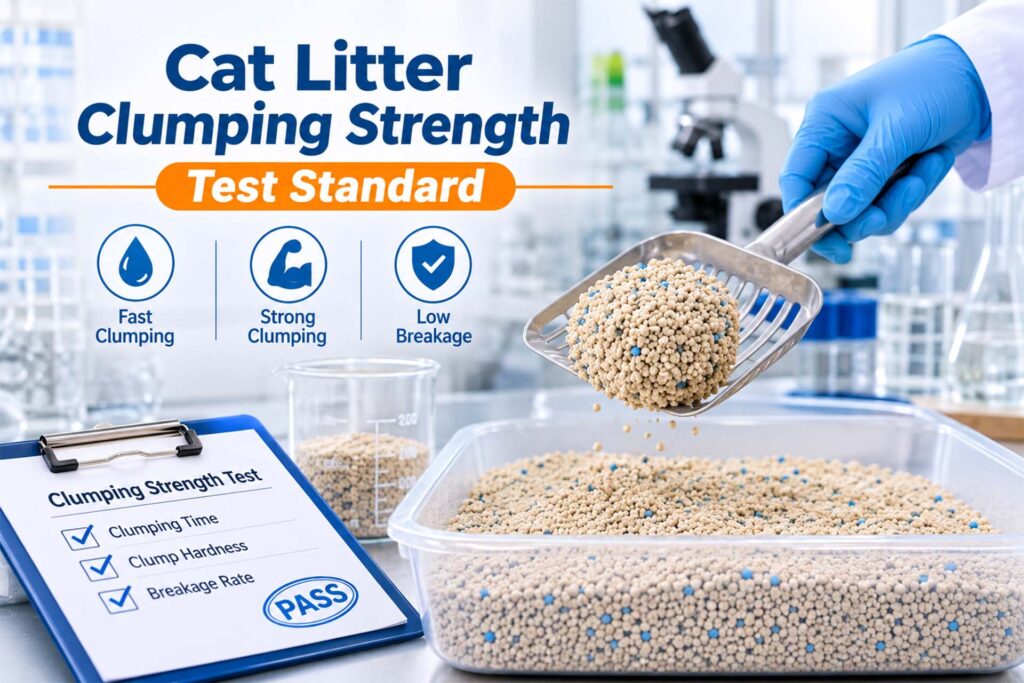
Ask five suppliers for their clumping strength figure and you will receive five numbers that cannot be compared. Not because one is lying, but because each used a different amount of liquid, a different bed depth, a different set time and a different definition of failure. A Cat Litter Clumping Strength Test Standard exists to remove that ambiguity.
That is the thing most buyers get wrong about a Cat Litter Clumping Strength Test Standard. They go looking for the threshold, the pass mark, the number that separates a good product from a bad one, and they come back with a figure from a brochure. What a standard actually fixes is not the number. It fixes the conditions under which the number means anything.
This Cat Litter Clumping Strength Test Standard sets out the method families in use, the five parameters that have to be written down before any of them produce a comparable result, and the clause that turns a test into something enforceable.
لمن يُعد هذا الدليل
For buyers, brand owners and quality staff who need to compare clumping performance across suppliers, batches or formulas, and who have discovered that the numbers on offer do not line up.
If you have not yet decided the material, choose first. Bentonite and plant-based granules bind by different mechanisms, so the protocol that suits one does not transfer cleanly to the other.
Why a Cat Litter Clumping Strength Test Standard Is a Protocol, Not a Number
A clump is the result of a sequence of physical events, and the sequence is short enough that small changes at the start decide the outcome. That is the first reason a Cat Litter Clumping Strength Test Standard has to describe the whole sequence rather than the final number.
Liquid first wets the granule surface, then penetrates the void spaces between particles, then moves downward and sideways under gravity and capillary action. Only after that does the mineral begin to absorb internally and swell, and the swelling is what binds neighbouring particles into one body. When the liquid reaches the bed evenly, particles across the wetted zone expand at roughly the same time and lock into a continuous internal network. When it concentrates in one spot first, that zone swells before its neighbours are even activated, and the clump forms with internal boundaries that fail later, usually during scooping.
This is why two products with identical absorption capacity can behave differently, and why a test that reports a single strength number while ignoring how the liquid was delivered is measuring something narrower than it claims. The protocol is not bureaucracy around the measurement. The protocol is the measurement. The four method families below are compared on their own terms in our guide to high-quality clumping standards, which covers what a finished clump should do rather than how to measure it.
The Method Families Behind Any Cat Litter Clumping Strength Test Standard
Four families cover most factory and laboratory practice behind a Cat Litter Clumping Strength Test Standard. They are not ranked; they answer different questions.
| Method family | What is actually measured | Best used for |
| Simulated liquid absorption | Absorption speed, formation time, clump size, surface integrity, liquid containment | Formula and batch comparison under identical conditions |
| Scoop simulation | Structural stability under lift, edge crumbling, fragmentation, residue | Predicting what a customer experiences at the tray |
| Compression | Force required to break a formed clump, as a trackable number | Trend monitoring and raw material comparison |
| Delayed removal | Integrity after extended residence, surface hardening, softening resistance | Multi-cat and infrequent-scooping markets |
The first is the most controlled and the least realistic. The second is the most realistic and the least repeatable by hand. The third produces the only number that can be charted over time. The fourth catches the formulas that pass a short test and fail a household.
A supplier that runs only one of these is not necessarily careless, but you should know which one, because the gap between them is where complaints come from. A clump that survives a laboratory measurement and collapses under a scoop is not a contradiction; the two tests are asking different questions. Published method collections such as AOAC Official Methods of Analysis exist for the same reason: a number is only comparable when the procedure behind it is fixed and named.
The Five Parameters in a Cat Litter Clumping Strength Test Standard
Every protocol below fixes one variable. Leave any one of them open and the number stops meaning what the supplier says it means.
Parameter 1: Liquid Volume and Delivery
What the protocol has to state
This is the variable that decides most of the result, and it is the one most often left vague.
Volume sets the size of the wetted zone. Delivery sets its shape. A measured pour from a fixed height produces a roughly circular, evenly wetted region; a slow trickle from a pipette produces a narrower, deeper column that reaches the lower layer before the surface is fully engaged. Both are legitimate tests, and they will rank the same two formulas differently.
So the protocol has to state the volume, the number of doses if the liquid is added in stages, the pour height, and the delivery device. It also has to state the liquid itself: temperature matters, because viscosity and capillary behaviour shift with it, and a synthetic urine substitute behaves differently from water. Whatever is chosen, it must be the same for every sample in the comparison, and it must be written down rather than assumed.
Without this parameter fixed, differences between suppliers that look like formula differences are often just different pour heights.
Parameter 2: Bed Depth and Sample Mass
Geometry changes with the bed
A clump is a three-dimensional object, and its geometry depends on how much material was there to bind.
Test in a shallow bed and the liquid reaches the tray bottom early, spreading sideways instead of downward; the resulting disc can look wide and strong while telling you nothing about behaviour in a bed twice as deep. Test in a deep bed and the clump becomes taller and more likely to fail along a horizontal plane under its own mass.
The protocol should therefore fix the container dimensions, the fill depth, and the mass of litter used, and it should say whether the material is settled, levelled or left loose. Loose fill and settled fill differ in bulk density at the point of contact, which changes penetration before swelling even begins.
This is also where the real-world divergence begins. Households do not maintain a standardised bed depth, and the differences are large: a shallow bed changes absorption patterns, while a deeper bed changes how clumps form and settle. A protocol that fixes one depth is a reference point, not a prediction.
Parameter 3: Set Time
Early binding and cured strength are different properties
Set time decides which property you are measuring.
Measure too early and you are measuring the rate of initial binding, which is a different quality attribute from cured strength and favours fast-wetting formulas. Measure after a fixed longer interval and you are measuring the strength of a fully developed clump, which is closer to what a household encounters but hides slow-curing failures. Some protocols measure both, and that is usually the more informative choice.
The practical requirement is that the interval is stated and identical across samples, and that the same interval is used when comparing a new batch to a historical reference. A figure quoted without a set time is not comparable even to another figure from the same supplier.
Parameter 4: Removal Method
Most clump failures happen at removal
Most clump failures happen at removal, so the removal method is part of the definition of strength rather than the step after it.
A scoop simulation lifts the clump with a standard scoop and examines what happens: whether the body holds, whether edges crumble, whether it fragments into pieces, and how much residue is left behind. The scoop geometry, the insertion angle and the lift speed all influence the outcome, which is why a protocol that says “removed with a scoop” without specifying them leaves room for two honest technicians to get different answers.
The compression route sidesteps this by applying force to a formed clump until it breaks, which is more repeatable and further from the real gesture. Delayed removal adds residence time before the same lift, and it is the test that most often separates formulas that looked equivalent in a short protocol.
Two of these three, run on the same samples, will tell you more than any one of them run carefully.
Parameter 5: The Failure Criterion
Write down what counts as broken
The last parameter is the one almost nobody writes down, and it is the reason two reports can both say “passed” about very different clumps.
Failure has to be defined. Is a clump that breaks into three pieces a failure, or only one that crumbles to residue? Is surface shedding at the edges acceptable if the body holds? Does a clump that survives the lift but leaves fragments in the bed count as passing?
The criterion should be expressed in observable terms that a second person could apply without asking. Where a numerical method is used, the criterion is a range rather than a single value, because a single fixed figure cannot hold across formulations, moisture and seasons. Where an observational method is used, the criterion is a description with a threshold, for example the proportion of the clump that must remain intact after a defined lift.
Once the criterion is written, a disagreement about a batch becomes a measurement question rather than an argument about impressions.
What the Mechanism Says About a Cat Litter Clumping Strength Test Standard
Particle structure drives liquid behaviour, and liquid behaviour drives the clump. That chain explains most of what a strength test is really detecting.
| Particle structure | Liquid behaviour | Clump outcome |
| Uniform granules | Stable flow channels | Dense, consistent clumps |
| Mixed fine and coarse | Unstable flow paths | Irregular clumps, weak zones |
| Overly fine particles | Slow penetration | Surface saturation, shallow binding |
| Overly coarse particles | Fast leakage | Weak bonding, poor containment |
Where a Cat Litter Clumping Strength Test Standard Diverges From a Real Litter Box
A protocol is a reference, and the reference is deliberately unlike a household. Three divergences matter commercially when you put a Cat Litter Clumping Strength Test Standard into a purchase specification.
Bed depth is not standardised in use, and both shallow and deep beds change clump geometry. Multi-cat households add frequency and disturbance, so the clump is exposed to more liquid and more mechanical interference before removal, and saturation arrives sooner. Automatic boxes add a third: rakes and rotating mechanisms apply loads that a clump can survive by hand and fail under automation, which makes scoop simulation the more relevant test for that channel even though compression gives the cleaner number.
For a buyer, this is an argument for specifying two tests rather than one, and for saying which channel the specification is written for.
Writing a Cat Litter Clumping Strength Test Standard Into the Contract
A Cat Litter Clumping Strength Test Standard that lives in an email thread is not a specification. Four elements move it into the contract.
First, the method: which family, and the five parameters above, stated as a reference procedure rather than a name. Second, the acceptance range, expressed against that method with the measurement point named. Third, the evidence: a per-batch certificate carrying the measured values, the method and the batch number. Fourth, the remedy: what happens when a batch falls outside the range, agreed before the first container rather than after it.
One verification detail is worth adopting because it catches a common substitution. Take the batch number from a bag of the actual goods and find the test report that covers it, then compare the report date with the production date. A report dated before the batch existed describes a different batch. It is evidence that a test was once run, not evidence about the product in front of you.
The bentonite and tofu lines bind by different mechanisms, so Aisha runs the protocol per line and records the result per batch rather than quoting a single house figure (company-cited). The three auditable quality gates page sets out what a buyer can check on site, and the factory walkthrough shows where sampling and test stages sit in the production sequence.
Delivery terms are a separate clause. Incoterms rules allocate the goods and the point at which risk passes; they do not define an acceptance range or a remedy for an off-spec batch. Keep the two documents distinct, and state in the purchase order which one governs the test result.
Three Mistakes in a Cat Litter Clumping Strength Test Standard
Three mistakes account for most of the bad comparisons buyers bring back from supplier calls.
Mistake 1: comparing numbers without conditions
Two suppliers quoting the same figure may have used different liquid volumes, bed depths and set times, in which case the figures agree by coincidence.
Ask for the conditions before you compare the results.
Mistake 2: testing only for maximum strength
Very hard clumps are not automatically better. Excessive hardness can increase sticking to the tray and reduce usable comfort, and the best-performing products balance clump strength against absorption speed, dust behaviour and scoopability.
Write the acceptance range around what your market needs, not around the highest number available.
Mistake 3: testing once, at the sample stage
A sample proves the formula can perform. Only per-batch data proves it does, and batch-to-batch drift is precisely what a clumping specification exists to catch.
Require the measurement per shipment, not per relationship.
Red Flags in a Cat Litter Clumping Strength Test Standard
- A strength figure with no stated test conditions
- A single fixed value where a range and a method belong
- Only one method used, with no scoop-level check
- A test report that predates the batch it claims to cover
- Results quoted for a formula family rather than a batch
- No stated failure criterion, so every batch “passes”
- Reluctance to share the procedure, only the outcome
What to Ask About a Cat Litter Clumping Strength Test Standard
Five questions about a Cat Litter Clumping Strength Test Standard do most of the work. Which method family is used, and why that one for this product. What are the fixed liquid volume, bed depth and set time. How is the clump removed, and what counts as failure. How often is the measurement taken, and is it per batch. And can you see a report whose date falls after the production date of a batch you can physically identify.
A supplier who answers all five is describing a process. A supplier who answers the first and deflects the rest is describing a brochure.
الخلاصة
A Cat Litter Clumping Strength Test Standard is not a threshold you look up. It is a protocol you specify: liquid volume and delivery, bed depth and sample mass, set time, removal method, and a failure criterion someone else could apply without asking you what you meant.
Fix those five, and the numbers from two suppliers become comparable for the first time. Leave them open, and you are comparing brochures.
الأسئلة الشائعة
Is there a single clumping strength number that means good quality?
No. Clumping strength has no universal benchmark outside its test method, channel tolerance, and test conditions. Scoop-simulation and compression tests measure different mechanical behaviors, so buyers must identify the method family first and compare figures only under matching liquid volume, litter bed depth, and set time.
Which method should I ask for first?
Start with scoop simulation because it reflects real litter-box removal behavior, and add compression testing when you need a quantitative metric to track stability across batches or time. Combining both on the same samples separates cohesive structural strength from real-world scoop integrity and residual fines.
Why do two suppliers report different numbers for similar products?
Apparent differences often stem from test parameters—such as liquid volume, bed depth, set time, pour height, and dosing device—rather than true product differences. Shallow beds promote lateral spreading, longer set times measure cured rather than initial strength, and unstandardized dosing changes clump geometry, making a written test protocol essential before comparing suppliers.
Can absorption and clumping be tested separately?
Yes. Fast liquid absorption does not guarantee a cohesive clump, so measuring absorption rate and clump strength separately isolates whether a bottleneck comes from granule size and porosity or from binding performance—preventing blind formula adjustments.
How soon after production should a clump test be run?
Run clump testing at a fixed post-production time interval and apply that exact same interval to every batch. Because moisture and internal equilibration shift after packing, testing on day one versus day ten is not apples-to-apples, and keeping the interval constant is required for valid historical tracking and retained-sample comparisons.
Do clump requirements differ between markets?
Yes—requirements vary by sales channel as well as destination market. Automatic litter boxes and multi-cat homes place heavier mechanical loads on clumps than single-cat manual scooping, and twice-daily scooping tolerates different clump behavior than once-daily scooping, so acceptance criteria should match the target channel and be stated in the test protocol.
What if a batch fails the agreed range?
Non-conforming batches should be governed by a pre-agreed contract remedy clause specifying rework, replacement, or credit alongside objective test triggers. Verify that the test report matches the bag lot number and carries a post-production date so out-of-spec disputes are resolved by measurement rather than subjective opinion.
 Arabic
 English
 Spanish
 Russian
 Japanese