When a container of cat litter leaves Dalian port, it may arrive at a pet supermarket in Hamburg, a warehouse club near Los Angeles, or the fulfilment centre of a start-up brand in Jakarta. AiSha — an OEM cat litter manufacturer based in Dalian, China — describes this journey repeating about two hundred times a month across 86 countries (company-cited figures).
The number 86 is a market map on the surface and a measure of supply-chain capability underneath: familiarity with 86 sets of regulations, insight into 86 sets of consumer preferences, and precise control of each delivery path. This guide explains how geography, scale and experience combine into a global factory model, and what emerging brands should look for when choosing an OEM cat litter manufacturer. All product and commercial details are company-cited statements to confirm in writing.
Why this matters to distributors, wholesalers and private-label brands: for a small brand the factory is not a vendor — it is the difference between a container of product and a store launch. The right manufacturer folds design, compliance and logistics into one order.
Основные выводы
- An OEM cat litter manufacturer’s real assets are geography, scale and experience: raw-material and port proximity, capacity with process stability, and export knowledge accumulated market by market.
- AiSha describes 25 years of export experience, deliveries to 86 countries, roughly 200 containers a month, and 300,000 tonnes of annual capacity (company-cited).
- One-stop OEM/ODM covers three layers: formula (particle size in a 1–3.5 mm window, hardness, absorbency, clump strength, scent, odour-factor dosing, dust rate), packaging (1.5 kg trial bags to 20 kg family bags), and logistics (FOB, CIF, DDP).
- Small-batch trials start from a few hundred boxes and use the same formula and packaging tools as bulk orders, so sample quality equals bulk quality and market data arrives before scale investment.
- Mixed-container loading puts several SKUs — different sizes, scents, formats, even wood-shaving and tofu lines — into one 20-foot container under one customs declaration.
- Customs risk hides in HS classification, origin and phytosanitary certificates, fumigation rules and label-language mandates; roughly 200 monthly containers keep declaration practice current.
- Regional preferences shift the specification: the Middle East favours larger granules and strong clumping, Europe demands environmental credentials, North America values shelf-ready packaging, and South-East Asia weighs price against moisture resistance.
Для кого предназначено данное руководство: emerging pet brands launching into new markets, distributors building a private-label line, independent-store owners planning store-branded litter, and e-commerce sellers who need custom formulas and mixed loads without factory-level minimums.
Comparing Order Models from an OEM Cat Litter Manufacturer
Two order models carry most first launches. Both reduce the entry bet, but they solve different problems: a trial answers “will it sell?”, while a mixed container answers “can I launch a range?”.
| Размер | Small-batch trial | Mixed-container order |
| Volume | Hundreds of boxes | One 20 ft container, many SKUs |
| Customisation | Same formula and packaging tools as bulk | Multi-SKU: size, scent, format |
| Лучшее для | Market validation, cost control | Launching a full range at once |
| Risk profile | Lowest entry cost | Shared freight, lower per-SKU MOQ |
| Typical next step | Lock the bulk specification in writing | Re-order the best-selling SKUs |
The Geography behind an OEM Cat Litter Manufacturer
Geography sets the cost floor. Dalian is one of the major gateways of north-east China, a deep-water port with shipping networks reaching Japan, Korea, South-East Asia, Europe and the Americas — and it sits close to the country’s bentonite-rich region, which keeps the raw-material radius short. Short material distance plus short port distance translates into stable delivery windows and competitive landed cost.
For an OEM cat litter manufacturer this is the quiet advantage behind every quotation: the same product costs less to source, process and ship, and capacity can flex in peak season without supply anxiety. Buyers evaluating factory location should read it as a logistics variable, not a postcode — see what a professional cat litter manufacturer in China should be able to document about material sourcing and port access.
Scale inside an OEM Cat Litter Manufacturer
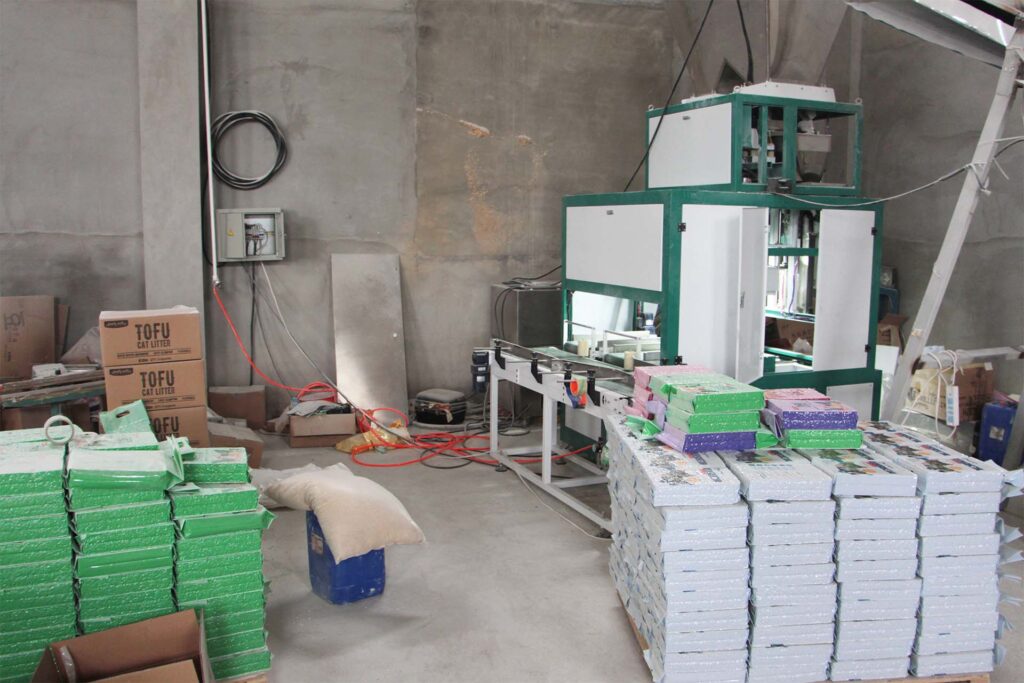
Scale sets the capacity ceiling. AiSha describes 300,000 tonnes of annual capacity and PLC-automated lines covering batching, sodium activation, granulation, drying, screening and packaging — digital process control that locks parameters into standards, so a ten-tonne order and a thousand-tonne order ship the same physical specification (company-cited). Automation also isolates quality from manpower swings: the line does not tire in peak season or lose skill in slow months. For buyers, scale means consistent quality you can contract for, and it is one reason larger channels treat capacity as a qualification gate. Consistency claims are best verified through per-batch test reports and third-party checks such as SGS.
Experience as an OEM Cat Litter Manufacturer’s Moat
Experience decides service precision. Twenty-five years of export and 86 destination countries accumulate into organisational memory: Middle East buyers prefer larger granules and strong clumping, European buyers are sensitive to environmental credentials, North American channels value shelf presentation and SKU flexibility, and South-East Asian buyers focus on value and moisture resistance. These are not desk research — they were learned through customs declarations, complaint handling and formula adjustments.
European expectations in particular are shaped by a mature regulatory and industry framework, which is why serious exporters track bodies such as FEDIAF, the European pet industry association. When a brand asks an OEM cat litter manufacturer to “make litter for my market”, the answer is a parameter selection, not an experiment: moisture control for hot dry climates, ingredient choices under European rules, granule curves for specific consumer habits.
One-Stop OEM/ODM from an OEM Cat Litter Manufacturer
The one-stop model folds the factory-investment barrier into a single cooperation. It works on three layers, and a capable OEM cat litter manufacturer should be able to quote all three in one order rather than referring you to outside vendors.
Formula-layer customisation
OEM customers take an existing product line and private-label it; ODM customers start from zero. Particle size within a 1–3.5 mm window, hardness, absorbency multiple, clump strength, scent (unscented, light or botanical), odour-factor dosing including the amount and distribution of blue and pink colour granules, and dust rate can all be combined for a target market. A useful test: ask the factory to state, in writing, which of these parameters are fixed by equipment and which are adjustable per order.
Packaging-layer customisation
Options range from 1.5 kg trial bags to 20 kg family bags, across stand-up pouches, laminated film, cartons and buckets, with multilingual design and shelf-fit. ODM customers can build a full visual identity — brand colours, logo, barcode and compliant labels — so the product is shelf-ready on arrival. Custom cat litter packaging is usually where a private-label launch is won or lost, because it is the only part of the specification the shopper actually sees.
Logistics and Incoterms support
FOB, CIF and DDP terms cover booking, loading, ocean freight and destination clearance, with carrier relationships that small brands cannot secure alone in peak season. The allocation of cost and risk between those terms is defined by the Incoterms® rules published by the International Chamber of Commerce, so confirm which rule set your quotation references and which edition. Practical capability in this layer is worth checking directly with the factory floor — the Завод по производству наполнителей для кошачьих туалетов AiSha (OEM/ODM) page lists the production and packaging scope that sits behind those trade terms.
Flexible Order Models: Small-Batch Trials and Mixed Containers
Growth-stage brands rarely need a full container of one SKU on day one. Two flexible models keep the first order small without making it unrepresentative.
Small-batch trials: evidence before investment
The rational path for a new brand is to test channel response, consumer reviews and repeat-purchase curves with a few hundred boxes, then scale what works. AiSha’s trial service applies the same formula and packaging customisation as regular orders — small orders are not treated as small jobs, and sample quality equals bulk quality (company-cited). Trials also do the settling-in work: packaging usability, label compliance gaps and climate fitness surface at the thousand-box scale, at a fraction of the cost of fixing them at the million-box scale. For the wider commercial logic, see this private label cat litter manufacturing guide.
Mixed containers: one container, one range
Traditionally, filling a 20-foot container with a single SKU needs roughly 25 tonnes of one product — a gamble for a start-up. A mixed load lets multiple SKUs share one container: different particle sizes, scents, packaging formats, even wood-shaving and tofu products together. Each SKU avoids its own minimum order, yet they all reach the shelf at once; multi-brand or multi-SKU loads are consolidated by the manufacturer through one customs declaration and freight plan, spreading the per-box logistics cost. The result is a product matrix without a factory-sized bet.
Customs and Freight with an OEM Cat Litter Manufacturer
Cross-border friction hides in documents and codes. Cat litter exports involve customs classification of mineral products, destination quarantine requirements and environmental rules — for example chemical declarations for clay-type products in the EU and inspection access rules for plant-fibre products in some countries. Any slip can hold cargo at port, generate demurrage, or force a full-container return.
Twenty-five years and 86 countries of declaration history is a hedge against exactly these risks. The classification logic itself follows the Harmonized System kept by the World Customs Organization, described in its own overview of what the Harmonized System (HS) is; a manufacturer’s practical familiarity with it is built through real clearances, not textbooks. Around 200 monthly containers keep a customs team in permanent live training (company-cited).
Documents to request before shipment
- Commercial invoice and packing list, matching the approved pro-forma line by line.
- Certificate of origin, where the destination or a preferential tariff agreement requires one.
- Phytosanitary certificate for plant-fibre products such as tofu, cassava or pine litter.
- Fumigation treatment record, where wooden pallets or packaging are subject to treatment rules.
- Labelling artwork in the destination’s mandatory language(s), with net weight and importer details.
3 Mistakes When Choosing an OEM Cat Litter Manufacturer
Mistake 1: Judging an OEM cat litter manufacturer by price alone
The cheapest ton can carry hidden costs: weaker clumps, higher dust, packaging that fails in transit, or customs delays. Compare landed cost, grade and service scope, not the unit price — and price the same specification across at least two factories before you commit.
Mistake 2: Ignoring the compliance record
Certificates, HS classification experience and destination documentation matter more than the showroom. Ask which markets the manufacturer actually ships to and which documents they routinely produce; a factory that has cleared your target port before will quote a shorter, cheaper path. The full evaluation sequence is set out in how to pick a cat litter manufacturer for OEM/ODM.
Mistake 3: Treating the small-batch trial as a one-off
A trial is a data-gathering exercise — test packaging, labels and climate fit, keep the approved sample, and use the results to lock the bulk specification in writing. Brands that skip the written lock-in usually discover the drift at the second container, not the first.
Storage and Incoming Checks with an OEM Cat Litter Manufacturer
Receiving checks that catch problems early
At receiving, verify the batch against the approved sample: particle size distribution, dust level, clump test and moisture. Check packaging integrity — print quality, seal strength and barcode readability — and confirm the declared net weight. Retain one sealed sample per batch for traceability, and agree replacement and compensation terms in writing before the first order.
Storage rules that protect the batch
Store on pallets off the floor in dry conditions; clay absorbs moisture, and plant-based products are even more sensitive. Rotate stock first-in first-out, keep bags away from direct sunlight, and re-check moisture after any prolonged humid spell. Most quality complaints that look like factory defects are in fact warehouse defects.
Conclusion: An OEM Cat Litter Manufacturer as Growth Partner
The supply chain’s ultimate product is partner success. AiSha’s 86-country story is really a global-brand incubation infrastructure: geography lowers the entry threshold, scale stabilises quality, experience dissolves cross-border complexity, and flexible services — small-batch trials and mixed loads — carry emerging brands through their growth curve (company-cited). For a brand with a local insight and a global ambition, the practical question is not whether to build a factory, but which OEM cat litter manufacturer can act as the factory it does not need to own.
Why this matters to distributors, wholesalers and private-label brands: the right partner converts fixed cost into variable cost. You keep capital for brand and channel while the factory carries equipment, compliance and freight risk.
For samples, formula customisation and mixed-container plans, submit an enquiry on the AiSha contact page, or review the official website for the full product range. All product claims and commercial terms must be confirmed in writing before purchase.
Часто задаваемые вопросы
What does an OEM cat litter manufacturer actually do?
An OEM cat litter manufacturer produces litter that a brand sells under its own label, and usually handles formula, packaging artwork and export paperwork in the same order. OEM means private-labelling an existing line; ODM means developing the formula and packaging from zero for your market.
Why does geography matter when choosing an OEM cat litter manufacturer?
Port and raw-material proximity set the cost floor. Shorter distances mean stable delivery windows, competitive landed cost and supply flexibility in peak season. A factory near both the bentonite source and a deep-water port can quote a lower landed cost for the same grade than one that trucks material several hundred kilometres first.
What is the difference between OEM and ODM cat litter production?
OEM private-labels an existing product line, so lead times are short and development cost is near zero. ODM builds a custom formula and packaging from zero — particle size, hardness, absorbency, clump strength, scent, odour-factor dosing and dust rate — which takes longer but gives a specification no competitor can buy off the shelf.
How small can a first order be with an OEM cat litter manufacturer?
AiSha describes small-batch trials starting from a few hundred boxes with the same customisation as bulk orders, and sample quality equals bulk quality (company-cited). Minimums vary by packaging format and print tooling, so confirm the trial MOQ in writing together with the unit price applicable if you scale.
What can go into a mixed container?
Multiple SKUs — different particle sizes, scents and packaging formats, even wood-shaving and tofu products — can share one 20-foot container under a single customs declaration. Each SKU avoids its own minimum order quantity, and the freight cost is spread across the whole load, which lowers the per-box landed cost at launch.
Which documents do cat litter exports need?
Typically a commercial invoice, packing list and certificate of origin. Some destinations add phytosanitary certificates for plant-fibre products, fumigation treatment records for wooden packaging, or mandatory label languages. Confirm the list per market before production, because document gaps are usually found at the port, not in the factory.
Which trade terms does AiSha support?
FOB, CIF and DDP options cover booking, loading, ocean freight and destination clearance (company-cited); confirm current terms and which Incoterms edition they reference in writing. DDP suits brands without an import entity; FOB suits those with their own freight forwarder and clearance agent.
How do I verify quality consistency across orders?
Ask for per-batch test reports and third-party checks such as SGS, keep the approved sample sealed, and run clump, dust, particle and moisture tests at every receiving. Consistency is contractible: write the acceptable ranges into the specification so a drift is a claim, not an argument.
 Russian
  English
  Spanish
  Japanese
  Arabic